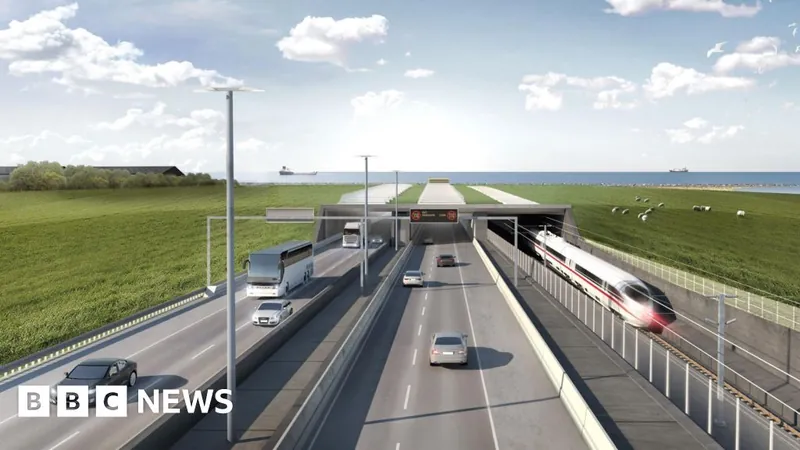
Breaking Barriers: The Spectacular Tunnel Connecting Denmark and Germany
2025-04-22
Author: Jacques
A Marvelous Engineering Feat Under the Baltic Sea
Imagine slashing travel times between Denmark and Germany with a groundbreaking tunnel that will redefine connectivity in Scandinavia and beyond! The Fehmarnbelt Tunnel, stretching an impressive 18 kilometers (11 miles) under the waters of the Baltic Sea, is set to become the world’s longest pre-fabricated road and rail tunnel.
Innovative Construction Methods Unveiled
Unlike typical underwater tunnels, which carve through bedrock, the Fehmarnbelt Tunnel will be constructed by assembling 90 massive pre-fabricated sections, laid on the seafloor, and pieced together like an intricate Lego set. This remarkable design not only pushes engineering boundaries but also promises to be more environmentally sustainable.
A Hub of Activity at Lolland's Construction Site
At the northern entrance of the tunnel on Lolland island, a sprawling construction facility covers over 500 hectares (1,235 acres) and hosts the manufacturing of tunnel elements. Henrik Vincentsen, CEO of Femern, the Danish state-owned company behind this ambitious project, describes it as a colossal operation, emphasizing the innovative methods being employed.
Revolutionizing Travel Across Borders
Once completed, the tunnel will drastically cut travel time: a car journey from Rødbyhavn in Denmark to Puttgarden in Germany will take just 10 minutes, and trains will zip through in a mere seven minutes, replacing the former 45-minute ferry ride. Most excitingly, this new route will halve the travel time between Copenhagen and Hamburg from five hours to just 2.5 hours.
Significant Environmental Enhancements
Designed with ecological considerations in mind, this project will also contribute to a greener future by reducing road travel and cutting carbon emissions as travelers will trek 160 kilometers less. Vincentsen proudly states, "Everybody's a winner; we're not just connecting Denmark to Germany, but bringing all of Scandinavia closer to central Europe!"
Navigating Challenges in Construction
The tunneling process is complex. To deploy each huge section of the tunnel, weighing over 73,000 tonnes, they will be towed and submerged precisely 40 meters into a trench on the seafloor, using high-tech underwater cameras for accuracy. A meticulous 'pin and catch' system will ensure that every element is perfectly aligned.
Environmental Concerns Addressed
Despite facing opposition from environmental groups concerned about potential ecological impacts, a German federal court ultimately approved the project in 2020. Femern has undertaken significant measures to mitigate environmental impact, including plans for a new wetland area on land reclaimed from the dredged materials.
The Future is Bright for European Connectivity
With an estimated cost of €7.4 billion ($8.1 billion) and significant funding from the European Commission, the Fehmarnbelt Tunnel stands as one of the largest infrastructure projects in Europe's recent history. As the final pieces come together, this engineering marvel promises to open up a new chapter in European travel and trade, paving the way for a more connected and sustainable future.



 Brasil (PT)
 Canada (EN)
 Chile (ES)
 Česko (CS)
 대한민국 (KO)
 España (ES)
 France (FR)
 Hong Kong (EN)
 Italia (IT)
 日本 (JA)
 Magyarország (HU)
 Norge (NO)
 Polska (PL)
 Schweiz (DE)
 Singapore (EN)
 Sverige (SV)
 Suomi (FI)
 Türkiye (TR)
 الإمارات العربية المتحدة (AR)