Breakthrough in Lunar Ice Search: Hawai‘i Researchers Make Exciting Advances!
2025-04-24
Author: Benjamin
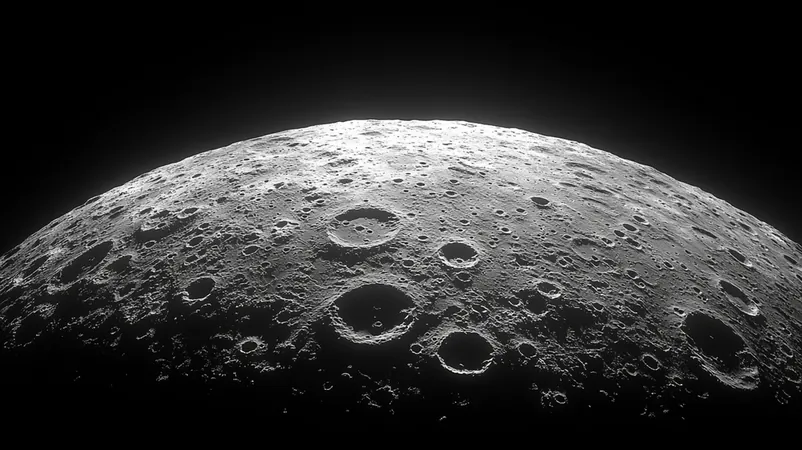
The Moon is more than just a shining orb in the night sky; it could be a treasure trove of ice, a resource that could sustain future lunar bases and provide key components for rocket fuel. As interest in lunar exploration intensifies, scientists from the University of Hawai‘i at Mānoa are pioneering innovative methods to uncover the mysteries of lunar ice.
Unveiling the Secrets of Shadowed Craters
In the hunt for water ice, researchers previously detected its presence in the Moon's permanently shaded polar regions. Now, a groundbreaking study led by Jordan Ando, a promising planetary sciences graduate student, is utilizing the cutting-edge "ShadowCam" aboard Korea's Lunar Pathfinder Orbiter.
This camera is uniquely designed to capture images in the darkest corners of the lunar surface, where sunlight doesn’t reach directly. By analyzing these high-quality images, the team sought to determine whether the presence of ice was causing any visible brightening in these shadowy zones.
Ando noted, "Ice tends to reflect more light compared to surrounding rocks. Our investigations reveal important data about how much ice may actually blanket the Moon's surface." While the initial findings didn't show a significant brightening, they did refine the estimated ice content, indicating that it constitutes less than 20% of the lunar surface.
Harnessing Cosmic Rays for Buried Ice Detection
But that's not all! Another team within UH Mānoa has uncovered an astonishing method to detect buried ice using cosmic rays, as detailed in a recent publication in *Geophysical Research Letters*. Lead author Emily Costello explained, "We're utilizing high-energy cosmic rays that penetrate the lunar surface, sending radar waves that bounce back from hidden ice layers, revealing what's beneath the surface."
This innovative approach combines advanced computer simulations with cutting-edge radar technology. Co-author Christian Tai Udovicic emphasized the novelty and excitement of this method, stating, "It’s a fresh avenue in the field, relying on high-energy physics few scientists specialize in." The implications could reshape our understanding of lunar resources.
Hawai‘i: The New Epicenter of Space Exploration
The research teams at HIGP and the Department of Physics and Astronomy are now gearing up to create a specialized radar system aimed at detecting these signals, with hopes to launch it to the Moon by early 2026. This ambitious goal could mark the first time large deposits of buried lunar ice are detected.
Costello concluded, "Hawai‘i is increasingly becoming a central hub for space exploration, particularly concerning lunar missions. Initiatives led by UH Mānoa not only pave the way for groundbreaking research but also open exciting opportunities for students and professionals in Hawai‘i to engage in the evolving space industry."



 Brasil (PT)
 Canada (EN)
 Chile (ES)
 Česko (CS)
 대한민국 (KO)
 España (ES)
 France (FR)
 Hong Kong (EN)
 Italia (IT)
 日本 (JA)
 Magyarország (HU)
 Norge (NO)
 Polska (PL)
 Schweiz (DE)
 Singapore (EN)
 Sverige (SV)
 Suomi (FI)
 Türkiye (TR)
 الإمارات العربية المتحدة (AR)