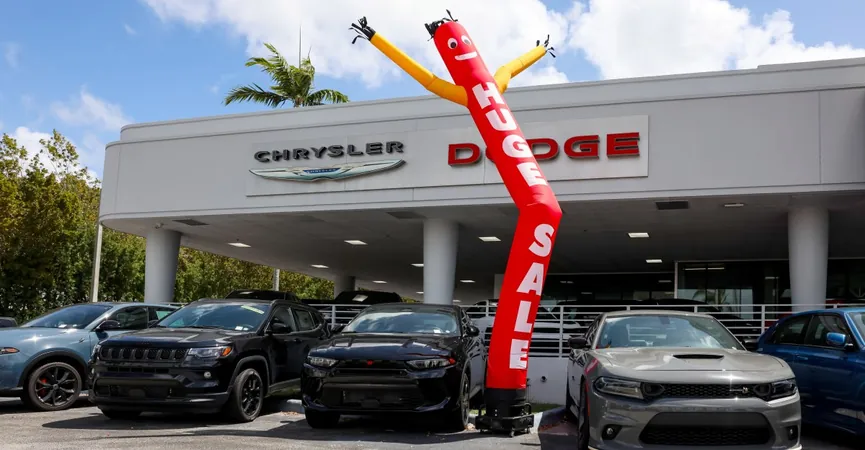
Confusion Reigns as Auto Tariffs Wobble: What's Happening in the White House?
2025-04-24
Author: Emily
In just 24 hours, the auto industry has found itself in a dizzying whirlwind of contradictory messages from the Trump administration regarding tariffs, culminating in two shocking announcements: while China might receive exemptions on tariffs for auto parts, Canada could face even higher tariffs on cars.
Reports from the Wall Street Journal initially suggested that President Trump was considering slashing the staggering 145 percent tariffs on China, possibly reducing them to a more manageable 50 percent. Investors looked on with cautious optimism, especially after Trump himself hinted at such reductions, stating, "145% is too high. It will come down substantially." However, Treasury Secretary Scott Bessent quickly shot down those claims, asserting that the U.S. would not lower tariffs unilaterally.
But wait! Just hours later, the Financial Times revealed that Trump was indeed eyeing a reduction of the newly imposed tariffs on steel, aluminum, and certain car parts from China, with the White House confirming to CNBC that exemptions were under consideration. While a full tariff rollback wasn’t on the table—25 percent tariffs on foreign-made vehicles and car parts would remain in place—this news sparked a sigh of relief among automakers struggling to keep costs in check.
However, the plot thickened. As automotive stocks momentarily surged in response, Trump took to the Oval Office podium to declare that it was Canada—not China—that could see increased auto tariffs. "They took a large percentage of the carmaking, and I want to bring it back to this country," he stated adamantly. "I really don’t want cars from Canada. When we put tariffs on Canada— they're paying 25 percent, but that could go up—we're just saying, ‘We don’t want your cars.’"
This chaotic saga of shifting tariff policies highlights the administration’s inconsistency in trade negotiations, leaving both the market and consumers on edge. Even with potential "destacked" exemptions on the horizon, the existing tariffs threaten to cripple the American auto industry. A coalition of major U.S. automotive players recently warned the administration that a 25 percent auto tariff could rack up costs by up to $107 billion.
They cautioned, "Tariffs on auto parts will scramble the global automotive supply chain and set off a domino effect that will lead to higher auto prices for consumers, lower sales at dealerships, and make servicing vehicles both more expensive and unpredictable." The stakes are high, and the future of the American auto market hangs in the balance.


 Brasil (PT)
 Canada (EN)
 Chile (ES)
 Česko (CS)
 대한민국 (KO)
 España (ES)
 France (FR)
 Hong Kong (EN)
 Italia (IT)
 日本 (JA)
 Magyarország (HU)
 Norge (NO)
 Polska (PL)
 Schweiz (DE)
 Singapore (EN)
 Sverige (SV)
 Suomi (FI)
 Türkiye (TR)
 الإمارات العربية المتحدة (AR)