Dinosaurs Roamed the Northern Hemisphere Millions of Years Earlier Than Believed!
2025-04-23
Author: Liam
Prepare to have your dinosaur knowledge turned upside down! A groundbreaking discovery reveals that dinosaurs may have roamed the northern hemisphere far earlier than anyone thought—over 230 million years ago!
A Tiny Dinosaur with an Epic Story
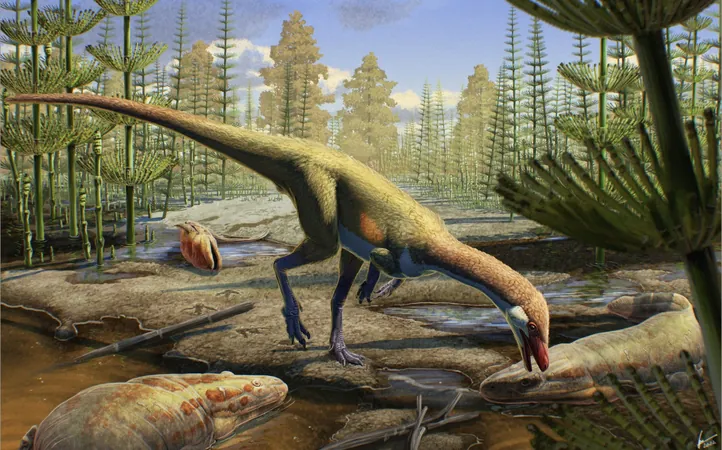
At what is now known as Wyoming, a newly identified dinosaur species, Ahvaytum bahndooiveche, was strutting its stuff during the Carnian stage of the Late Triassic. Imagine a chicken-sized dinosaur, only about a foot tall and three feet long, with a long, swaying tail—no giant monsters here, just a small but significant player in the dinosaur saga!
The Fossil That Changes Everything
For years, scientists assumed dinosaurs originated in the southern hemisphere of the supercontinent Pangaea and took millions of years to ascend north. The discovery of Ahvaytum, whose fossilized remains were unearthed by University of Wisconsin–Madison researchers, shakes this antiquated timeline and provides evidence that dinosaurs were indeed basking in northern soils much earlier!
Rewriting the Dinosaur Timeline
Using cutting-edge dating methods, researchers have determined that the rock strata where Ahvaytum was found dates back to around 230 million years ago. This places it contemporaneously with early dinosaurs in Gondwana, challenging the notion that northern dinosaurs didn’t appear until 6 to 10 million years later!
Rethinking Dinosaur Distribution
Ahvaytum bahndooiveche is not just the oldest known dinosaur from the northern hemisphere; it raises critical questions about the dispersal patterns of dinosaurs. Could it be that dinosaurs spread rapidly across the globe, thriving in a variety of environments much sooner than believed?
Dinosaur Diversity in a Changing Climate
This thrilling finding coincides with the Carnian Pluvial Episode, a time when the Earth's climate shifted dramatically, creating wetter conditions that likely enabled these early dinosaurs to thrive and expand their habitats. Could it be that harsh environmental barriers weren't the restraints scientists previously thought?
A Community Effort in Science
The story doesn’t just end with fossils—Ahvaytum's name, meaning 'long ago dinosaur,' is culturally significant as it was a joint effort with the Eastern Shoshone Tribe, intertwining Indigenous knowledge with modern science. It exemplifies a collaborative spirit that’s often missing in research!
Filling in the Gaps in Our Knowledge
Why were these fossils hidden from scientists for so long? Northern fossil beds have often been overlooked due to poor preservation conditions. Lovelace emphasizes that this discovery bridges crucial gaps in our understanding of dinosaur evolution.
A New Era in Paleontology
This tiny dinosaur may be small, but it's making a colossal impact on our understanding of Earth’s ancient history. The revelation of Ahvaytum bahndooiveche reminds all of us that profound changes in scientific knowledge can arise from the most unexpected discoveries.



 Brasil (PT)
 Canada (EN)
 Chile (ES)
 Česko (CS)
 대한민국 (KO)
 España (ES)
 France (FR)
 Hong Kong (EN)
 Italia (IT)
 日本 (JA)
 Magyarország (HU)
 Norge (NO)
 Polska (PL)
 Schweiz (DE)
 Singapore (EN)
 Sverige (SV)
 Suomi (FI)
 Türkiye (TR)
 الإمارات العربية المتحدة (AR)