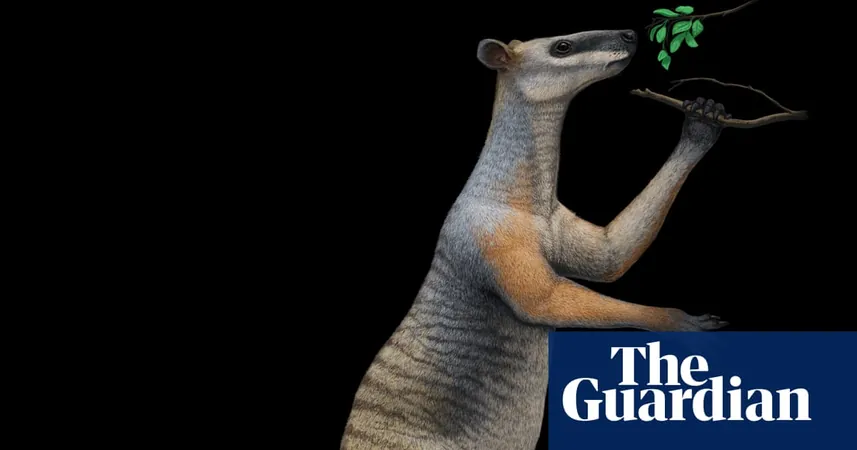
Forget the Outback: Why Giant Prehistoric Kangaroos Were the Ultimate Homebodies
2025-04-23
Author: Liam
Giant Kangaroos: Surprisingly Homebound!
Despite their colossal size, prehistoric giant kangaroos, known as Protemnodon, were surprisingly homebodies, preferring the comfort of a small territory over extensive roaming, according to groundbreaking Australian research.
Meet the Megafauna of Queensland
These enormous creatures, which roamed Australia from 5 million to about 40,000 years ago, dwarfed today’s kangaroos, with some tipping the scales at a staggering 170 kg—more than double that of the largest modern red kangaroo.
Expectations vs. Reality: A Shift in Understanding
Researchers anticipated that larger body sizes in these prehistoric mammals might mean wider ranges, similar to how today’s red kangaroos can traverse great distances. However, a revelatory study led by University of Wollongong palaeo-ecologist Chris Laurikainen Gaete suggested otherwise.
Fossil Teeth Reveal the Truth
Analysis of fossil teeth unearthed near Mt Etna, north of Rockhampton in Queensland, disclosed that these giant kangaroos preferred a snug, localized habitat. "These gigantic kangaroos were just chilling at home, eating the plentiful rainforest leaves," said co-author Dr. Scott Hocknull, hinting at a stable environment that kept them close to their limestone caves.
The Perils of Staying Put
Evolving as real homebodies in a resource-rich rainforest seemed to work well for Protemnodon until environmental shifts began around 280,000 years ago. The climate changed, leading to increased aridity that disrupted their rainforest home, highlighting the vulnerabilities linked to their limited range.
A Glimpse into a Varied Past
Palaeontologist Dr. Isaac Kerr, not involved in the study, noted that Protemnodon fossils mostly found in the south and east indicate various species adapting to different environments, possibly spanning the continent, including New Guinea. These stockier relatives, resembling today's wallaroos, displayed distinct physical characteristics.
Mt Etna: A Treasure Trove of Fossil Wonders
Renowned as one of Australia’s richest fossil sites, Mt Etna offers insights into ancient Pleistocene rainforests, revealing how shifting climates transformed lush habitats into arid landscapes.
Next Steps in Palaeontological Research
The research team is set to explore fossils from smaller kangaroo species still present today, like tree kangaroos and rock wallabies, to decipher how they adapted while their giant cousins went extinct.
Innovative Techniques Unlock the Past
By comparing unique chemical signatures found in local geology to those in fossilized teeth, the researchers shed light on the ranges occupied by these magnificent creatures. The innovative use of strontium signatures can help unravel the mysteries behind the disappearance of certain megafauna from specific locations.
A Paradigm Shift in Understanding Extinction
Hocknull expressed that this research significantly alters how palaeontologists and ecologists interpret the fossil record, opening up new avenues for understanding past animal behaviors.



 Brasil (PT)
 Canada (EN)
 Chile (ES)
 Česko (CS)
 대한민국 (KO)
 España (ES)
 France (FR)
 Hong Kong (EN)
 Italia (IT)
 日本 (JA)
 Magyarország (HU)
 Norge (NO)
 Polska (PL)
 Schweiz (DE)
 Singapore (EN)
 Sverige (SV)
 Suomi (FI)
 Türkiye (TR)
 الإمارات العربية المتحدة (AR)