Max Verstappen's Strategic Silence: A Deep Dive into His Penalty Response
2025-04-20
Author: Charlotte
Why Max Verstappen Chose Silence After His Penalty
Max Verstappen’s reaction to the fallout from his Saudi Arabian Grand Prix penalty was akin to a masterclass in strategic silence. After stepping out of his Red Bull F1 car, the reigning world champion faced a barrage of questions, particularly from pre-podium interviewer and Red Bull ambassador David Coulthard. In a surprising turn, Verstappen sidestepped inquiries about a crucial first-corner incident that significantly influenced the race.
Instead of addressing the issue, Verstappen focused on thanking fans in Jeddah, casually dismissing the race with the phrase "it is what it is," and expressing his eagerness for the upcoming Miami Grand Prix before making a quick exit to avoid further questioning.
A Tactical Retreat from Controversy
In front of F1’s broadcast crews, his reluctance to engage further was palpable. When pressed about the five-second penalty he received for leaving the track while battling McLaren's Oscar Piastri, Verstappen brushed it off as a 'waste of time' to discuss.
When comparisons were drawn between his racing against Piastri and a previous incident involving Lando Norris at Austin, he remarked, "this is not my problem, to be honest," swiftly steering the conversation back to Red Bull’s performance, a topic he was clearly more comfortable discussing.
In the Spotlight: Press Conference Dynamics
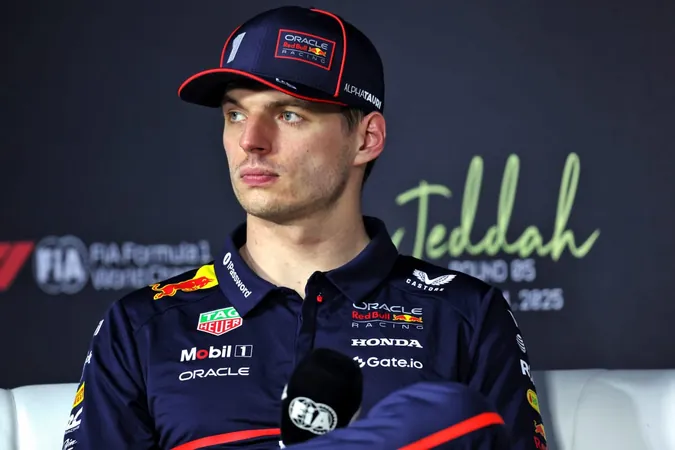
Later, during the FIA’s press conference, Verstappen maintained his silence about the penalty. He answered questions regarding car performance articulately but remained elusive when it came to specific incidents.
When host Tom Clarkson asked him to reflect on the start of the race, all Verstappen offered was a vague, "The start happened, Turn 1 happened, and suddenly it was lap 50…" followed by a pause that spoke volumes.
Verstappen's Reasoning Behind the Silence
Journalist Samarth Kanal attempted to unravel Verstappen's rationale for this quiet stance. The driver pointed to two main concerns: the fear of being misinterpreted on social media and the risk of facing further penalties for criticizing FIA officials. "I prefer not to talk. Sometimes your words can be twisted, so it’s better not to say too much," he stated.
Verstappen has previously faced backlash for defending his family and friends amid social media uproars. This has made him increasingly cautious about his public engagements, with a noticeable reduction in his media commitments, especially after past controversies.
A Stand Against Restrictions
His silence can also be viewed as a protest against what he perceives as the FIA’s growing restrictions on driver expression. Verstappen noted that while he is aware of the organization’s new swearing ban, his inability to openly critique decisions makes him hesitant to share his opinions.
"You can’t share your full opinion because it’s not appreciated... for me, it’s better to say less. It saves time, and it seems that’s how everything is going now. Everyone is sensitive about everything," he explained.
Conclusion: Silence as Strategy
Ultimately, Verstappen's choice to adopt a 'no comment' approach appears to be a tactical decision aimed at avoiding trouble rather than an indication of unwillingness to engage. By refraining from discussing contentious topics, he aims to protect himself from penalties and maintain focus on performance within the sport. As Verstappen navigates the increasingly fraught landscape of F1 media relations, his silence speaks volumes.



 Brasil (PT)
 Canada (EN)
 Chile (ES)
 Česko (CS)
 대한민국 (KO)
 España (ES)
 France (FR)
 Hong Kong (EN)
 Italia (IT)
 日本 (JA)
 Magyarország (HU)
 Norge (NO)
 Polska (PL)
 Schweiz (DE)
 Singapore (EN)
 Sverige (SV)
 Suomi (FI)
 Türkiye (TR)
 الإمارات العربية المتحدة (AR)