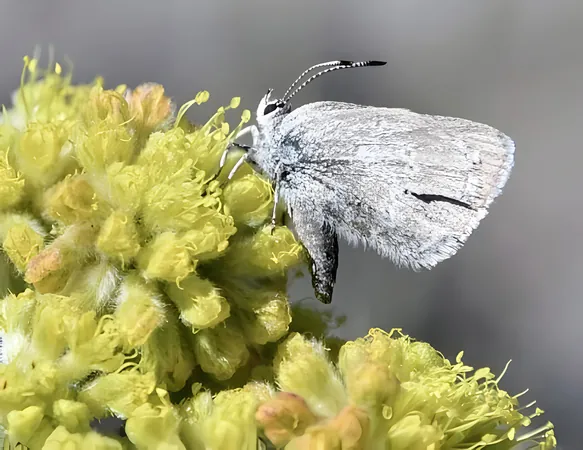
Meet Canada’s Mysterious Butterfly: The Curiously Isolated Hairstreak!
2025-04-21
Author: Michael
A Stunning Discovery in Canada’s Rocky Mountains
In the breathtaking wilderness of Canada’s Rocky Mountains, scientists have unveiled a remarkable secret—a brand-new butterfly species that has been hiding in plain sight!
Once thought to be a mere lookalike of the Half-moon Hairstreak, the butterflies from the Blakiston Fan region have officially been designated as Satyrium curiosolus, affectionately dubbed the Curiously Isolated Hairstreak.
40,000 Years in the Making
This groundbreaking discovery not only highlights the butterfly's unique look but also traces its extraordinary evolutionary journey. Estimates suggest that these butterflies have remained genetically and ecologically distinct from their closest relatives for around 40,000 years!
Zac MacDonald, a leading researcher from UCLA’s Institute of the Environment and Sustainability, noted the fascinating findings from their whole-genome sequencing: this butterfly boasts strikingly low genetic diversity and has faced significant historical inbreeding compared to its relatives located over 400 kilometers away.
Adaptation and Survival: A Natural Marvel
Remarkably, this small species has thrived independently for millennia. MacDonald likens its survival tactics to the Channel Island Fox—a unique adaptation process may have allowed S. curiosolus to shed deleterious genes, adapting to its isolated surroundings.
Unlike its cousins that dwell in sagebrush ecosystems, the Curiously Isolated Hairstreak thrives in a prairie-grassland habitat, dependent on the silvery lupine as its sole host plant.
An Enigmatic Partnership with Ants
But that’s not all! Researchers have unveiled a fascinating mutualistic relationship between the larvae of S. curiosolus and a specific ant species, Lasius ponderosae. This unexpected alliance has not been observed in other related populations.
The caterpillars secrete honeydew, which the ants happily consume in exchange for protection from predators. These clever caterpillars even seek shelter in ant nests during tough weather!



 Brasil (PT)
 Canada (EN)
 Chile (ES)
 Česko (CS)
 대한민국 (KO)
 España (ES)
 France (FR)
 Hong Kong (EN)
 Italia (IT)
 日本 (JA)
 Magyarország (HU)
 Norge (NO)
 Polska (PL)
 Schweiz (DE)
 Singapore (EN)
 Sverige (SV)
 Suomi (FI)
 Türkiye (TR)
 الإمارات العربية المتحدة (AR)