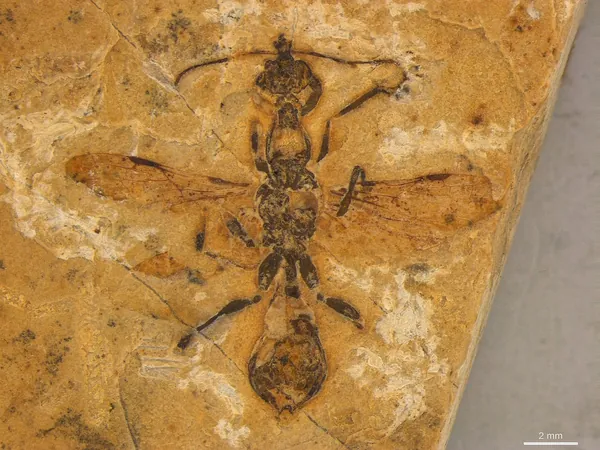
Meet the 113-Million-Year-Old 'Hell Ant': The Oldest Ant Discoveries Just Got More Fascinating!
2025-04-24
Author: Liam
A Groundbreaking Discovery in Brazil
In an astonishing find, scientists have uncovered a 113-million-year-old 'hell ant' in northeastern Brazil, marking it as the oldest ant specimen known to date. Published in Current Biology, this discovery sheds light on the remarkable evolution of these ancient predators.
What Are Hell Ants?
This particular hell ant, preserved in limestone, is part of the extinct subfamily Haidomyrmecinae, which thrived during the Cretaceous period. What sets hell ants apart? Their menacing, scythe-like jaws were perfectly adapted for pinning or impaling prey, underscoring their fierce predatory lifestyle.
Revolutionizing Our Understanding of Ant Evolution
Anderson Lepeco, a researcher at the Museu de Zoologia da Universidade de São Paulo, stated, "Our team has discovered a new fossil ant species representing the earliest undisputed geological record of ants." This find not only introduces a novel species but also challenges previous notions regarding ant distribution and diversity during ancient times.
A Unique Geological Context
Previously, the oldest known ants were found encased in amber from locations such as France and Burma. The existence of a hell ant in Brazil illustrates that these insects were already widespread, suggesting a much earlier diversification than scientists had assumed.
The Significance of This Finding
Lepeco emphasized the significance of their discovery, noting, "When I encountered this extraordinary specimen, we recognized its importance immediately. This finding not only confirms a new species but serves as critical evidence of ants in the Crato Formation, renowned for its remarkable fossil preservation."
Advanced Imaging Reveals Astonishing Details
Using micro-computed tomography, a 3D imaging technique, researchers examined the ant in unprecedented detail. Intriguingly, this fossil is closely related to hell ants known only from Burmese amber specimens, reinforcing the idea that these creatures once roamed vast distances across ancient landmasses.
Astonishing Anatomical Features
What truly astonished the researchers were the specialized features of the feeding apparatus. Unlike modern ants with side-moving mandibles, this hell ant had mandibles that extended forward, a unique trait indicating complex evolutionary adaptations even at such an ancient stage.
New Questions About Evolutionary Pressures
The discovery compels researchers to ponder the evolutionary pressures that led to such the unique adaptations of hell ants. Lepeco stated, "Finding such an anatomically specialized ant from 113 million years ago challenges our assumptions about how quickly these insects developed complex traits." With advanced imaging tools, there's now an opportunity to explore fossil specimens with unparalleled clarity.
The Future of Brazilian Paleontology
This finding not only enhances our understanding of ancient ants but also shines a light on the importance of Brazilian paleontology, urging further exploration of its unexplored fossil insect fauna. As research continues, we may uncover even more secrets of our planet's prehistoric inhabitants.



 Brasil (PT)
 Canada (EN)
 Chile (ES)
 Česko (CS)
 대한민국 (KO)
 España (ES)
 France (FR)
 Hong Kong (EN)
 Italia (IT)
 日本 (JA)
 Magyarország (HU)
 Norge (NO)
 Polska (PL)
 Schweiz (DE)
 Singapore (EN)
 Sverige (SV)
 Suomi (FI)
 Türkiye (TR)
 الإمارات العربية المتحدة (AR)