Meet the Mind-Blowing 'Worm' Creature That Roamed 50 Million Years Ago!
2025-04-20
Author: Liam
A Groundbreaking Discovery in Paleontology!
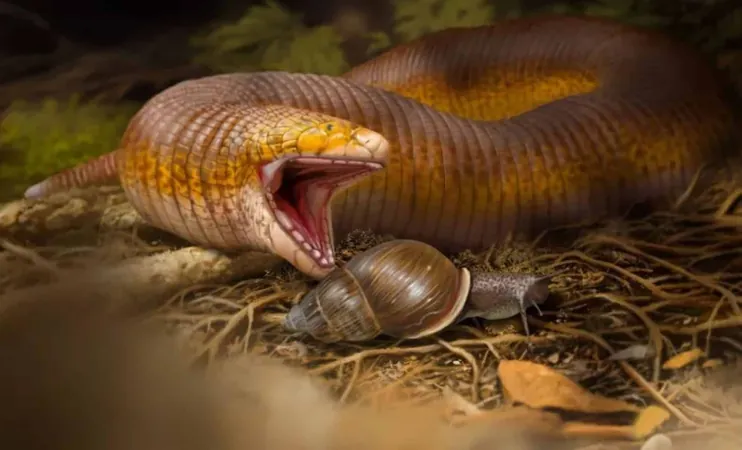
Paleontologists are buzzing with excitement over the recent discovery of a prehistoric giant, the Terastiodontosaurus marcelosanchezi, the largest worm lizard ever identified! This remarkable species, unveiled in a study published in the Zoological Journal, measured over 3 feet long, shattering previous notions about the size of these burrowing reptiles.
The Ancient Titan That Defied Expectations
Unearthed in the stunning Djebel Chambi National Park, Tunisia, the fossils of T. marcelosanchezi hail from a time 50 million years ago, during the Eocene epoch. Unlike today's smaller, limbless worm lizards, this colossal creature likely roamed visibly and confidently above ground.
Georgios Georgalis, the lead author of the study, pointed out, “This is large for amphisbaenian standards,” highlighting how this discovery challenges previous assumptions about the biology and ecology of worm lizards.
A Real-Life Sandworm: The Extraordinary Anatomy
The striking features of this ancient reptile have drawn intriguing comparisons to the legendary sandworms from the Dune universe. Georgalis adds, “Visually, you can imagine the animal as a ‘sandworm’ from the Dune science fiction novels and their movie adaptation.”
But there’s more than just aesthetics; the T. marcelosanchezi was an apex predator, equipped with robust jaws and thick tooth enamel, aimed at crushing hard-shelled prey like snails.
History-Making Size: The Largest Worm Lizard Ever!
This groundbreaking species boasts a skull length exceeding 2 inches, eclipsing every known worm lizard both extinct and contemporary. Research suggests that T. marcelosanchezi belongs to the Trogonophid family, an intriguing lineage of worm lizards from North Africa.
The fossils, mostly consisting of jaws and vertebrae, indicate that multiple individuals were preserved, showcasing a diversity of sizes.
A Warm Climate Breeds Giants
This discovery offers tantalizing clues about its connection to the warmer climate of the Eocene epoch. Co-author Krister Smith from the Senckenberg Research Institute posits, “We think that the unusual body size is related to the higher temperatures in this period of the Earth’s history,” which could indicate a trend toward larger reptiles during warmer periods.
An Evolutionary Marvel With a Mighty Bite!
In stark contrast to modern trogonophids, which rarely exceed a few inches, T. marcelosanchezi was an evolutionary oddity, showcasing extreme and unique dental adaptations. These features would have equipped it with a highly effective, destructive bite, making it a dominant predator in its ecosystem.
With its impressive size and surface-dwelling lifestyle, this remarkable creature reveals a significant shift from the burrowing habits seen in its smaller descendants.
The revelation of Terastiodontosaurus marcelosanchezi not only expands our understanding of prehistoric life but also leaves us wondering what other astonishing discoveries await us in the depths of history!



 Brasil (PT)
 Canada (EN)
 Chile (ES)
 Česko (CS)
 대한민국 (KO)
 España (ES)
 France (FR)
 Hong Kong (EN)
 Italia (IT)
 日本 (JA)
 Magyarország (HU)
 Norge (NO)
 Polska (PL)
 Schweiz (DE)
 Singapore (EN)
 Sverige (SV)
 Suomi (FI)
 Türkiye (TR)
 الإمارات العربية المتحدة (AR)