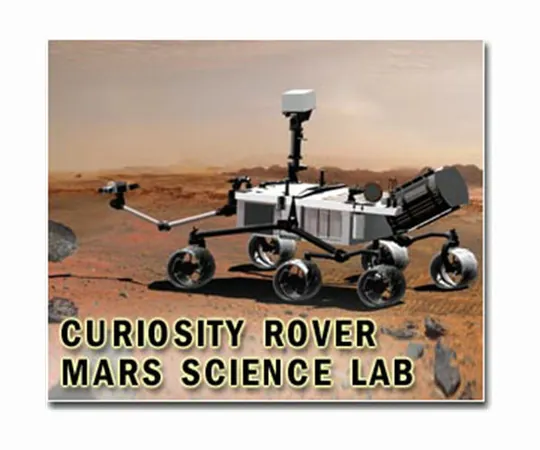
NASA's Curiosity Rover Unveils Shocking Clues About Mars' Ancient Climate
2025-04-23
Author: Jacques
A Groundbreaking Discovery on the Red Planet
In a stunning revelation, NASA's Curiosity rover has unveiled evidence of a once-thriving carbon cycle on Mars, shining new light on the planet’s past and its potential to harbor life. This remarkable find opens a window into the ancient Martian climate that might have been warm and wet—conditions that could have supported living organisms.
The Team Behind the Breakthrough
Leading the charge is Dr. Ben Tutolo, a geoscientist from the University of Calgary, who is part of the Curiosity rover's science team. His passionate quest aims to decode the climatic transitions and habitability of early Mars. The exploration is not just academic; it addresses fundamental questions about life's potential beyond Earth.
Mount Sharp: A Treasure Trove of Data
Published in the prestigious journal *Science*, the latest findings arise from Curiosity’s diligent analysis of drill samples taken from Mount Sharp, located inside Gale Crater. Curiosity detected siderite—an iron-rich carbonate mineral—embedded in sulfate-rich rock formations across three different locations. This mineral is believed to have been created in an environment rich in carbon dioxide, lending significant credence to theories about a warmer, wetter Mars.
A Puzzle of Ancient Environments
Dr. Tutolo heralded the discovery, stating, "The large carbon deposits found in Gale Crater represent a momentous shift in our understanding of Mars’ geological and atmospheric journey." Curiosity has focused on these deposits from the outset of its mission, revealing not just the presence of carbonates, but critical evidence that Mars underwent a drastic transformation from a once-habitable environment to the cold, desolate world it is today.
The History of Carbon and Mars
While theories have long speculated that carbonates formed under a thick, CO2-laden atmosphere, hard evidence has been elusive—until now. The findings bolster the narrative of Mars having hosted a functional carbon cycle during its formative years. Over its journey since landing in 2012, Curiosity has trekked over 34 kilometers of Martian terrain and suggests the ancient atmosphere had sufficient carbon dioxide to support liquid water.



 Brasil (PT)
 Canada (EN)
 Chile (ES)
 Česko (CS)
 대한민국 (KO)
 España (ES)
 France (FR)
 Hong Kong (EN)
 Italia (IT)
 日本 (JA)
 Magyarország (HU)
 Norge (NO)
 Polska (PL)
 Schweiz (DE)
 Singapore (EN)
 Sverige (SV)
 Suomi (FI)
 Türkiye (TR)
 الإمارات العربية المتحدة (AR)