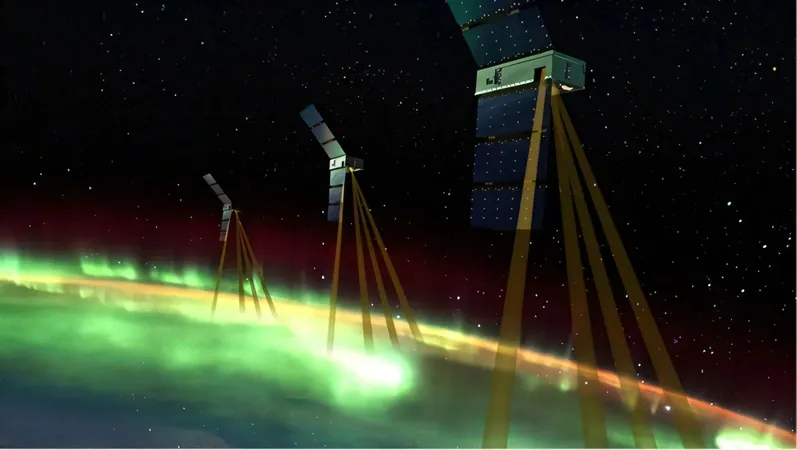
NASA's EZIE Mission Unveils Stunning New Insights into Earth's Auroras
2025-04-24
Author: Michael
Groundbreaking First Light Observations from EZIE
NASA's Electrojet Zeeman Imaging Explorer (EZIE) mission has officially captured its first-ever measurements, marking a thrilling milestone in our understanding of the mysterious forces at play in Earth's atmosphere.
Revealing the Secrets of Auroral Electrojets
These exciting "first light" observations are set to unveil essential information about auroral electrojets—powerful electric currents racing through the upper atmospheric layers where striking auroras illuminate the skies. This knowledge is crucial for understanding our planet's connection to space and for devising strategies to shield society from the impacts of space weather.
A Trio of CubeSats Takes to the Skies
Launched in mid-March, EZIE comprises three CubeSats designed to observe and map the auroral electrojets in unprecedented detail. These intense electric currents are found in the polar regions, roughly 65 miles (105 kilometers) above the Earth's surface, generated when solar wind energy surges into the upper atmosphere. It's during this extraordinary exchange of energy that the captivating northern and southern lights come to life.
Microwaves and Magnetic Fields: The Science Behind EZIE's Success
The innovative technology aboard EZIE maps the strength and direction of these electric currents by analyzing emissions from oxygen molecules located about 10 miles (16 kilometers) below the electrojets. Specifically, these molecules emit microwaves at a frequency of 118 gigahertz.
Here's where it gets fascinating: when these emissions encounter magnetic fields—like those generated by the electrojets—a phenomenon called Zeeman splitting occurs. This causes the emission line at 118 GHz to split further apart, and the degree of this splitting indicates the strength of the magnetic field, revealing crucial information about its direction.
A Successful First Capture!
On March 19, one of the three EZIE satellites successfully detected the Zeeman splitting of the 118 GHz oxygen emission line for the very first time using its Microwave Electrojet Magnetogram (MEM) instrument. The results provided insights into the strength and direction of the magnetic field influenced by Earth's own magnetic forces near the magnetic equator.
Anticipation Builds for Full Science Investigations
"The EZIE team is incredibly thrilled about these first-light results," expressed Sam Yee, principal investigator at the Johns Hopkins Applied Physics Laboratory. "These observations confirm that both the spacecraft and the MEM instrument are functioning perfectly as intended."
With formal science investigations slated to kick off in about a month, after final checks and calibrations, the excitement surrounding the EZIE mission continues to grow. The findings from this groundbreaking endeavor promise to enhance our knowledge of the intricate dance between Earth's atmosphere and space, holding the potential to transform our understanding of space weather impacts.



 Brasil (PT)
 Canada (EN)
 Chile (ES)
 Česko (CS)
 대한민국 (KO)
 España (ES)
 France (FR)
 Hong Kong (EN)
 Italia (IT)
 日本 (JA)
 Magyarország (HU)
 Norge (NO)
 Polska (PL)
 Schweiz (DE)
 Singapore (EN)
 Sverige (SV)
 Suomi (FI)
 Türkiye (TR)
 الإمارات العربية المتحدة (AR)