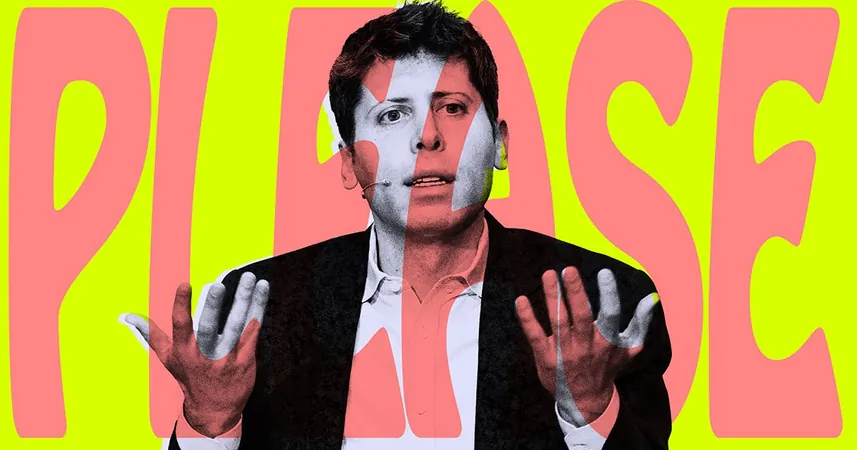
Sam Altman Reveals the High Cost of Politeness: Are 'Please' and 'Thank You' Burning a Hole in Our Wallets?
2025-04-19
Author: Michael
In a world where online politeness reigns, OpenAI CEO Sam Altman has dropped a bombshell: saying "please" and "thank you" to AI assistants like ChatGPT might be costing millions.
After a curious user on X, formerly Twitter, posed a question about the financial impact of such etiquette, Altman admitted that this phenomenon is indeed racking up costs, amounting to "tens of millions of dollars well spent." What does he mean by that? Well, it appears that there is a method to this seemingly trivial madness.
Despite the initial perception that addressing chatbots with courtesy is pointless, experts argue otherwise. Kurtis Beavers, a design manager at Microsoft, contends that using polite language fosters respect and generates more productive interactions. According to him, "Using polite language sets a tone for the response."
Research suggests that politeness can influence the quality of AI-generated outputs. A memo from Microsoft WorkLab highlights that when AIs recognize polite prompts, they're more inclined to reciprocate kindness. The results can lead to clearer, more professional exchanges between humans and machines.
A recent survey from late 2024 revealed that a surprising 67% of U.S. respondents make it a point to be nice to their chatbots. For many, courtesy isn't just a habit; 55% of respondents claimed it's simply the right thing to do, while 12% worry it's wise to appease potential future AI overlords.
But as we chuckle at our intelligent companions, it's essential to recognize the ramifications of this behavior. An investigation highlighted by the Washington Post, in collaboration with the University of California, revealed that sending a single AI-generated 100-word email consumes 0.14 kilowatt-hours of electricity—enough to power 14 LED lights for an hour. If you maintain a routine of sending one AI email weekly, that translates to a staggering 7.5kWh annually, equivalent to the power consumption of nine households in Washington, D.C.
Now consider the enormous volume of prompts we collectively feed to these chatbots each day, and the environmental impact becomes alarmingly evident. Current estimates suggest AI data centers contribute around 2% to global energy consumption, a figure expected to rise as AI continues to permeate daily life.
So, if you're deliberating whether to express gratitude to your AI companion, perhaps it’s time to reconsider. Ditching the chatbot for traditional methods might not just save some electricity; it could also be a more mindful choice for our planet.
Stay tuned for more fascinating insights on AI and its implications!



 Brasil (PT)
 Canada (EN)
 Chile (ES)
 Česko (CS)
 대한민국 (KO)
 España (ES)
 France (FR)
 Hong Kong (EN)
 Italia (IT)
 日本 (JA)
 Magyarország (HU)
 Norge (NO)
 Polska (PL)
 Schweiz (DE)
 Singapore (EN)
 Sverige (SV)
 Suomi (FI)
 Türkiye (TR)
 الإمارات العربية المتحدة (AR)