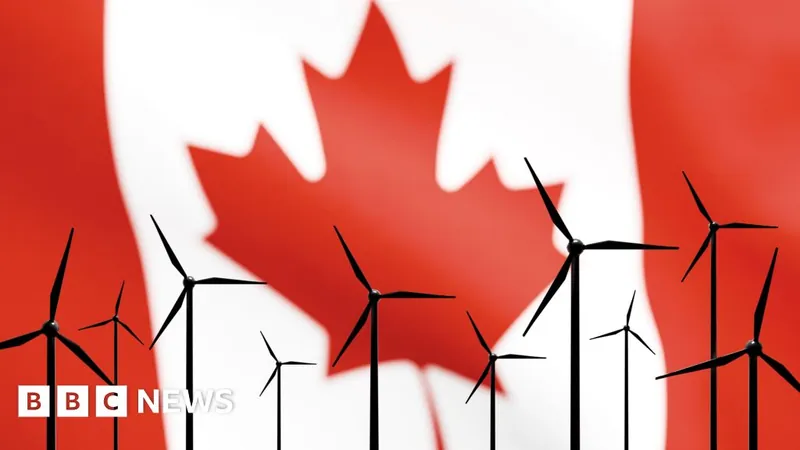
Shifting Focus: Canada’s Election Candidates Clash Over Energy and Climate Policies
2025-04-21
Author: Sophie
Canada's Election Takes a New Turn from Climate to Energy Interests
As Canada's federal election heats up, the looming shadow of US President Donald Trump is stealing the spotlight from a critical issue: the nation’s role in combating climate change.
The two main political contenders, Mark Carney of the Liberals and Conservative leader Pierre Poilievre, are unveiling plans for new energy infrastructures, reflecting a shift in focus away from environmental concerns as Canada aims to diversify its energy sources beyond the US.
From Green Promises to Fossil Fuel Priorities
Gone are the days when climate issues topped voter concerns. In the last election, both parties agreed on the need for a swift transition to a green economy, culminating in the passage of a net-zero emissions law. However, that consensus appears to have evaporated.
Carney, who assumed leadership of the Liberals in March, has a storied history as an advocate for climate action, having served as the Governor of the Bank of England and the UN Special Envoy on Climate Action. Ironically, his first major act as prime minister was the repeal of the consumer carbon tax—a hallmark of the Liberal climate agenda.
The Carbon Tax Controversy: Political Gamble or Missed Opportunity?
The consumer carbon tax, implemented in 2019 to reduce reliance on fossil fuels, quickly became a target for criticism, particularly from the Conservatives, who blamed it for rising living costs. Poilievre even labeled Carney as "Carbon Tax Carney" in an attempt to paint his rival as out of touch.
Opinions are divided on the tax repeal. Some view it as a clever political maneuver; others, including experts like Catherine Abreu, argue it reinforces the narrative that climate policies are burdensome and costly, missing a chance to reshape the climate dialogue in Canada.
Carney's Vision: Green Superpower or Status Quo?
In his campaign, Carney pitches Canada as a potential "global superpower" in both clean and traditional energy, calling for investments in environmentally friendly infrastructure and technologies like carbon capture. Yet, actual details of these ambitious plans remain sparse.
Despite Carney’s green ambitions, more pressing issues have surfaced. Recent polls highlight a decline in public concern over climate change, overshadowed by soaring energy and housing costs. The Ukraine war has further intensified focus on Canada’s vast energy resources, posing questions about the long-term sustainability of these fossil fuel pursuits.
Navigating a Shifting Geopolitical Landscape
The dynamics surrounding energy supply have dramatically evolved, with geopolitics pushing Canada’s natural resources into the global spotlight. Allies are increasingly turning to Canada for oil, gas, and critical minerals to offset reliance on Russia, complicating the electoral landscape.
In this context, many Canadians are primarily curious about which leader can best manage the contentious relationship with the US, particularly regarding energy tariffs that could jeopardize jobs and the economy.
Resurrecting Pipeline Discussions Amidst Environmental Concerns
Both the Conservatives and Liberals are advocating for the fast-tracking of energy corridors to transport resources from western provinces to new international markets. Previous attempts, like the shelved Energy East pipeline, faced backlash and regulatory challenges.
As this election progresses, Carney finds himself in a difficult position: balancing national security concerns related to US dependence while attempting to appease environmentalists wary of his fluctuating pipeline support.
As Canada heads to the polls, the complex interplay of energy policy, climate action, and international relations is set to shape the future of the country's political landscape.



 Brasil (PT)
 Canada (EN)
 Chile (ES)
 Česko (CS)
 대한민국 (KO)
 España (ES)
 France (FR)
 Hong Kong (EN)
 Italia (IT)
 日本 (JA)
 Magyarország (HU)
 Norge (NO)
 Polska (PL)
 Schweiz (DE)
 Singapore (EN)
 Sverige (SV)
 Suomi (FI)
 Türkiye (TR)
 الإمارات العربية المتحدة (AR)