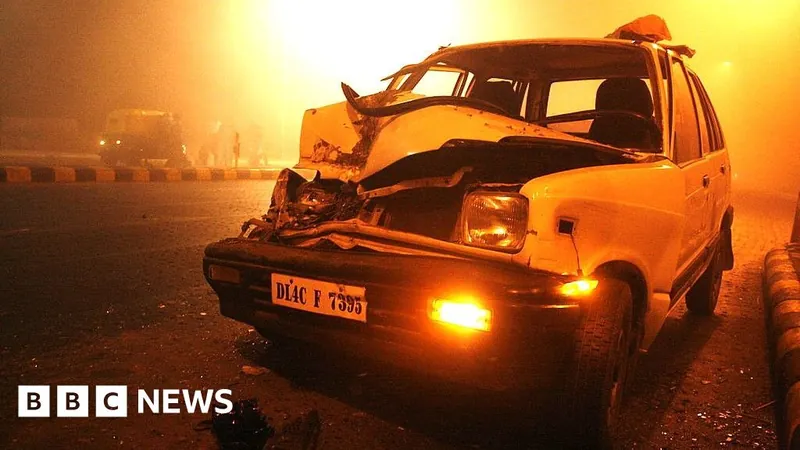
The Grim Reality: Why India's Roads Are a Death Trap
2025-04-21
Author: Olivia
A Death Every Three Minutes!
In a shocking revelation, a staggering 172,000 lives were lost on Indian roads in 2023, averaging a heart-breaking fatality every three minutes. Daily headlines reflect these tragedies—from buses tumbling into ravines to intoxicated drivers wreaking havoc on pedestrians.
A Crisis Beyond Infrastructure
While the official fatality report for the year is yet to release, India's Road Transport and Highways Minister, Nitin Gadkari, painted a dark picture during a national safety conference. In just one year, over 10,000 children fell victim to road accidents, primarily occurring near schools and colleges. The deadly stats add up, with 35,000 pedestrians and thousands of two-wheeler riders among the fatalities, largely due to speeding and neglecting safety measures.
The Perils of Negligence
Incredibly, as many as 54,000 individuals died because they weren't wearing helmets, while another 16,000 lost their lives for not buckling up. The issues go deeper, with overloading and unlicensed driving contributing significantly to road disasters.
Traffic Chaos Amplifies Dangers
India's roads are a medley of chaos, with cars, motorbikes, bicycles, and even stray animals competing for space. Street vendors spill into thoroughfares, pushing pedestrians into traffic and amplifying the hazards.
A Burden on the Economy
These alarming statistics not only represent a humanitarian crisis but also impose an economic toll, with road accidents costing India around 3% of its annual GDP. Despite having the world's second-largest road network, a multitude of factors contribute to its deadly nature.
The Human Factor
Gadkari pointed out a dire lack of respect for road laws as a major culprit. Underscoring that human behavior accounts for the lion's share of accidents, he simultaneously acknowledged flaws in civil engineering practices that exacerbate the dangers on Indian roads.
Flawed Road Designs Lead to Crashes
Infrastructure audits have revealed serious shortcomings. Crash barriers are often incorrectly installed, intended to safeguard vehicles yet instead causing them to flip over. The metal dividers, designed to manage high-speed traffic, frequently fail to mitigate risks.
Highway Horror Stories
A highway near Delhi starkly illustrates these failures, where a lack of safety precautions invites danger. The elevated roads that were meant to protect have become treacherous, with sudden vertical drops posing lethal risks for unsuspecting drivers.
A Call for Change
Minister Gadkari has ambitious plans to upgrade thousands of kilometers of roads, but experts warn that simply widening roads won’t solve the crisis. They stress the need for tailored road designs that meet India's unique needs rather than mere copies of Western systems.
Implementing Sustainable Solutions
To combat this escalating crisis, the government is adopting the "5Es" strategy: Engineering, Education, Enforcement, and Emergency care. Experts highlight that timely emergency care could have saved nearly half of those fatalities. Key states are stepping up to target high-risk areas, transforming them into safer zones.
Towards a Safer Future
Development shouldn't come at the cost of human life. For progress to be sustainable, it must ensure that the most vulnerable, like pedestrians and cyclists, aren’t left behind. If India doesn’t adapt its road safety measures soon, it risks smooth roads leading to a future of faster cars and more deaths.



 Brasil (PT)
 Canada (EN)
 Chile (ES)
 Česko (CS)
 대한민국 (KO)
 España (ES)
 France (FR)
 Hong Kong (EN)
 Italia (IT)
 日本 (JA)
 Magyarország (HU)
 Norge (NO)
 Polska (PL)
 Schweiz (DE)
 Singapore (EN)
 Sverige (SV)
 Suomi (FI)
 Türkiye (TR)
 الإمارات العربية المتحدة (AR)