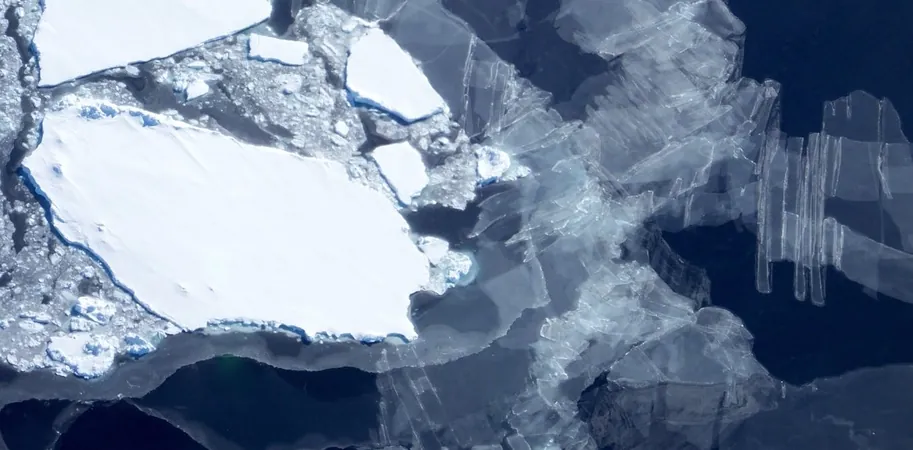
Unlocking Climate Secrets: Satellites Reveal Hidden Underwater Waterfalls in Antarctica
2025-04-22
Author: Liam
Beneath the Antarctic: A Hidden Climate Engine
Deep beneath the Southern Ocean, a phenomenon akin to underwater waterfalls is taking place. Cold, dense water cascades off the Antarctic continental shelf, plunging thousands of meters to the ocean floor. These enigmatic flows are crucial to the global ocean circulation, acting like a conveyor belt that redistributes heat, carbon, and essential nutrients across the planet, thereby regulating our climate.
The Challenge of Observation
For years, scientists have grappled with the difficulty of observing these remote underwater waterfalls, often found in some of the most turbulent and ice-covered waters on Earth. Their paths are sometimes squeezed through narrow canyons, making them easily overlooked by traditional research vessels.
A Revolutionary Breakthrough: Watching from Space
Recent research has transformed our approach by leveraging satellite technology. By detecting tiny fluctuations in sea level—mere centimeters—scientists can now track these underwater cascades from orbit, offering a groundbreaking method to monitor deep ocean circulation as it changes due to increasing greenhouse gas emissions.
The Importance of Dense Water for Climate Regulation
Dense water forms in the Antarctic when sea ice grows, increasing the salinity and density of the surrounding water. This heavy water then cascades down steep underwater slopes, flowing northward along the ocean floor and transporting vital oxygen and nutrients while absorbing carbon and heat from the atmosphere.
A Worrying Trend: The Impact of Climate Change
However, this vital process is at risk. The melting Antarctic ice sheet contributes fresh water to the ocean, complicating the formation of dense water. Studies indicate that abyssal currents have already slowed by 30%, with further weakening anticipated, potentially diminishing the ocean's capacity to absorb heat and carbon and accelerating the impacts of climate change.
Innovative Monitoring with Satellite Technology
Previously, monitoring these underwater flows relied heavily on expensive ships, sensors attached to marine animals, and static moorings. In contrast, satellite technology presents a cost-effective solution, utilizing radar systems like CryoSat-2 and Sentinel-3A to measure ocean surface heights with remarkable precision.
A Game-Changing Method: Detecting Sea Level Dips
Our latest study combined nearly ten years of satellite observations with advanced ocean models specific to the Ross Sea, a hotspot for dense water formation. We successfully identified subtle sea level dips that signal the presence of these cascading currents, confirming the viability of satellite monitoring for tracking changes in deep ocean circulation.
Economical and Eco-Friendly: A New Frontier in Climate Monitoring
This initiative marks the first instance of tracking Antarctic dense water cascades from space. The implications are tremendous—providing an efficient method for long-term monitoring with zero carbon emissions, capitalizing on satellites already in operation. As climate change accelerates, such innovative techniques are crucial for understanding and adapting to a rapidly evolving global climate.
Eyes on the Future: Enhancing Climate Adaptation Strategies
With this new capability to monitor ocean currents from space, we equip ourselves with the tools needed to better understand climate patterns. This advancement could lead to more effective strategies to combat climate change impacts, making it a vital development in our quest for climate resilience.



 Brasil (PT)
 Canada (EN)
 Chile (ES)
 Česko (CS)
 대한민국 (KO)
 España (ES)
 France (FR)
 Hong Kong (EN)
 Italia (IT)
 日本 (JA)
 Magyarország (HU)
 Norge (NO)
 Polska (PL)
 Schweiz (DE)
 Singapore (EN)
 Sverige (SV)
 Suomi (FI)
 Türkiye (TR)
 الإمارات العربية المتحدة (AR)