Unlocking Mars: Revolutionary Study Reveals Volcanic Secrets and Clues to Ancient Life!
2025-04-19
Author: Emma
New Insights from Mars's Jezero Crater!
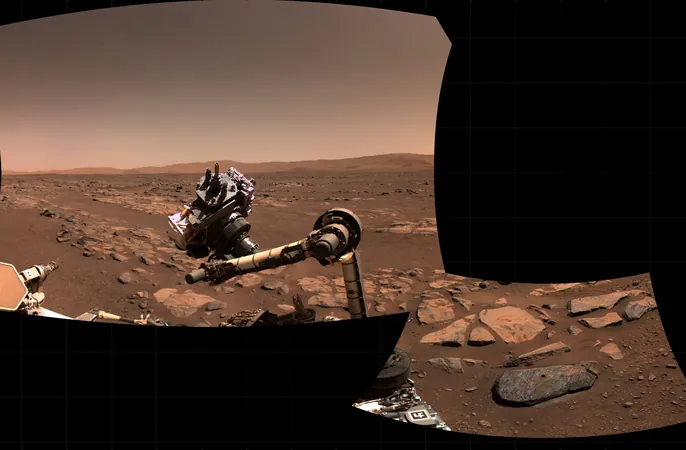
A groundbreaking study featuring a Texas A&M University scientist has unveiled stunning revelations about the Jezero Crater on Mars, the landing site of NASA's Perseverance rover. Researchers suggest the crater's floor is a rich tapestry of iron-laden volcanic rocks, offering a thrilling glimpse into Mars's ancient past—an unprecedented chance to find evidence of former life!
The Quest Begins with Perseverance!
NASA's most sophisticated robotic explorer, Perseverance, touched down in Jezero Crater on February 18, 2021, with a mission to uncover signs of ancient microbial life on the red planet. This rover is at the forefront of the Mars 2020 mission, diligently collecting core samples of Martian rock and soil that could one day be analyzed on Earth.
Cutting-Edge Technology Transforms Exploration!
Dr. Michael Tice, a research scientist specializing in geobiology, is part of a dynamic international team redefining our understanding of Mars. The technology aboard Perseverance, including groundbreaking tools like the Planetary Instrument for X-ray Lithochemistry (PIXL), allows scientists to analyze rock compositions like never before. "It's akin to having a mobile lab on another planet," Tice emphasized, highlighting the rover's ability to gather extensive data about Martian geology.
A Glimpse into Mars’s Volcanic History!
The research revealed two distinct volcanic rock types within Jezero Crater. The first type, dark and iron-rich, features interwoven minerals like pyroxene and plagioclase, while the second, lighter volcanic rock called trachy-andesite, showcases plagioclase crystals in a potassium-rich matrix. This discovery points to a complex volcanic system characterized by diverse lava flows.
Implications for Habitability!
The study utilized thermodynamic modeling to recreate how these minerals formed, indicating a history of vigorous volcanic activity. Tice remarked, "The processes of fractional crystallization and crustal assimilation we observe here are akin to volcanic systems on Earth. This means Mars may have had prolonged volcanic activity, potentially creating an environment rich in life-sustaining compounds!"
The Future of Mars Exploration!
This revelation is pivotal in assessing Mars's habitability. If volcanic activity persisted for extended periods, it could have created conditions favorable for life in Mars's earlier history. Tice noted, "These carefully chosen rocks hold vital clues to understanding Mars's environments. Once we retrieve the samples and analyze them with advanced Earth-based instruments, we'll delve deeper into their history and any biological signatures they hold."
A Decade-Long Mission Set to Change Everything!
The Mars Sample Return mission, a joint endeavor between NASA and the European Space Agency, aims to bring these precious samples back to Earth within the next decade. The data gleaned from these samples could redefine our understanding of life beyond Earth and the geological history of our neighboring planet.



 Brasil (PT)
 Canada (EN)
 Chile (ES)
 Česko (CS)
 대한민국 (KO)
 España (ES)
 France (FR)
 Hong Kong (EN)
 Italia (IT)
 日本 (JA)
 Magyarország (HU)
 Norge (NO)
 Polska (PL)
 Schweiz (DE)
 Singapore (EN)
 Sverige (SV)
 Suomi (FI)
 Türkiye (TR)
 الإمارات العربية المتحدة (AR)