Unlocking the Universe: NASA’s Roman Telescope Reveals Ambitious Survey Plans
2025-04-24
Author: Amelia
In an electrifying update, NASA's Nancy Grace Roman Space Telescope team has unveiled sweeping plans for three major surveys that promise to transform our understanding of the cosmos. Set to launch by May 2027, this mission aims to tackle the most pressing mysteries in astrophysics while providing a closer look at the universe like never before.
Diving Deep into Cosmic Mysteries
"The Roman mission is poised to conduct wide and deep surveys of the universe, addressing key questions about dark energy, dark matter, and the diverse worlds beyond our solar system," stated Gail Zasowski, a University of Utah professor and co-chair of the Roman Observations Time Allocation Committee (ROTAC). The stated goal is to ensure these surveys not only captivate scientists but also support multiple groundbreaking scientific applications.
The Roman Space Telescope is engineered to capture high-resolution panoramic views and conduct rapid surveys, creating unprecedented opportunities for groundbreaking research. By incorporating feedback from over 1,000 scientists worldwide, the Roman team has finalized plans for three crucial surveys.
Three Groundbreaking Surveys Await!
These initial survey designs will account for 75% of Roman’s exploration during its five-year primary mission, with the remaining time reserved for proposals from the scientific community.
"The culmination of two years of collaboration has brought us to this exciting milestone," said Julie McEnery, NASA Goddard’s senior project scientist for Roman. "We’re eager to see how this data will drive discoveries ranging from distant galaxies and dark matter to exploding stars and burgeoning black holes."
Survey Highlights: What’s in Store?
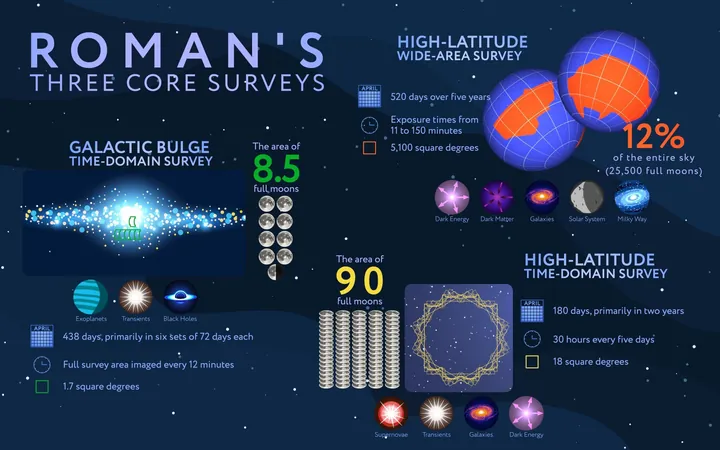
High-Latitude Wide-Area Survey
Roman’s most extensive survey, the High-Latitude Wide-Area Survey, will use imaging and spectroscopy to map over a billion galaxies across cosmic time. Positioned above the dust of the Milky Way, Roman will provide unrivaled clarity to study the formation and distribution of these galaxies. Such insight aims to shed light on the nature of dark energy and its role in the universe’s accelerating expansion.
High-Latitude Time-Domain Survey
Next up is the High-Latitude Time-Domain Survey, which will offer dynamic observations of celestial phenomena over various time frames. By capturing the same regions repeatedly, this survey enables scientists to create 'movies' of cosmic changes, allowing them to investigate hundreds of thousands of type Ia supernovae—critical for measuring cosmic distances and tracing universal expansion.
Galactic Bulge Time-Domain Survey
In contrast, the Galactic Bulge Time-Domain Survey will focus on the heart of our Milky Way, providing deep insights into hundreds of millions of stars. This survey will look for microlensing signals—gravitational effects that can indicate the existence of planets in various orbits, including potentially habitable zones.
The Roman telescope’s observations could identify previously hidden rogue planets, brown dwarfs, and stellar remnants, alongside uncovering new worlds through star-dimming events called transits.
The Future is Bright!
With all major hardware ready, the Roman mission is entering its final stages before launch, which may open a new chapter for cosmic exploration. Data from every survey will be made publicly available, ensuring rapid access for astronomers and boundless avenues for exploration.
"The sheer volume of data Roman will produce is set to revolutionize our quest for knowledge about the universe," McEnery concluded. Buckle up, because the journey to the stars starts soon!



 Brasil (PT)
 Canada (EN)
 Chile (ES)
 Česko (CS)
 대한민국 (KO)
 España (ES)
 France (FR)
 Hong Kong (EN)
 Italia (IT)
 日本 (JA)
 Magyarország (HU)
 Norge (NO)
 Polska (PL)
 Schweiz (DE)
 Singapore (EN)
 Sverige (SV)
 Suomi (FI)
 Türkiye (TR)
 الإمارات العربية المتحدة (AR)