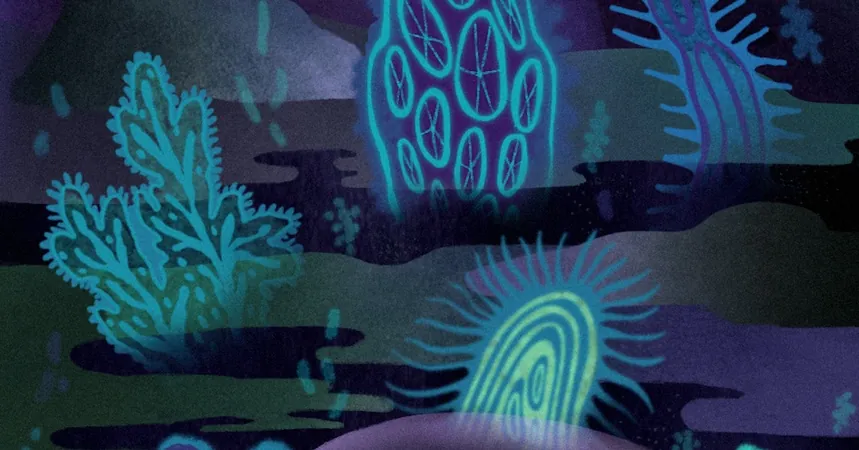
Unveiling the Hidden Life Beneath Earth's Crust
2025-04-18
Author: Michael
Life in the Shadows: The Hidden Ecosystem of the Ocean Floor
Imagine a secluded oasis in the cold, dark depths of the ocean where life thrives despite the absence of sunlight. This enchanting realm revolves around cold methane seeps where diverse species—including clams, mussels, crabs, and even bizarre worms—gather like wildlife at a watering hole. These seeps, exposed through tectonic shifts, release ancient methane trapped beneath the Earth's crust, providing vital energy in an otherwise desolate environment.
Microbes: The Unsung Heroes of Deep Earth
For microbiologists, these microorganisms are a treasure trove of intrigue. Since the discovery of life forms thriving deep within Earth's crust in the 1980s, we have only begun to comprehend the extraordinary resilience of these intraterrestrials. This deep, dark habitat challenges our fundamental understanding of life and its boundaries, showcasing forms of survival beyond our wildest imaginations.
A Surprising Reality: Life Without Light
Rather than yearning for the sun, these microbes flourish underground, subsisting on energies derived from chemical interactions. Surprisingly, they can metabolize even toxic elements like arsenic and radioactive uranium, playing a vital role in detoxifying our environment. In stark contrast to surface life that relies heavily on sunlight and oxygen, these organisms survive with astonishing efficiency, repurposing elements from the periodic table.
Timeless Existence: Life in the Slow Lane
Some of these microorganisms can endure for hundreds of thousands or even millions of years. Their minute lifecycles run at a snail's pace, taking decades to replace their cellular components. This begs the question: How do species evolve when the concept of progeny is foreign to their existence? They may not experience daily or seasonal changes, but geological events like plate movements evidently shape their evolution.
Impact on Climate: The Role of Subsurface Microbes
Buried in antiquity, these microbes not only sustain themselves but also contribute significantly to Earth's oxygen levels and nutrient cycling. As glaciers melt and thawing permafrost releases ancient carbon, subsurface microbes may unleash greenhouse gases—which could spell disaster for our climate. We must consider their influence on climate change models, as these ancient beings may hold deeper insights into potential remedies.
The Hidden Treasure: Resources Below the Surface
While the prospect of deep-sea mining for precious metals becomes increasingly enticing, it poses grave risks. The intricate ecosystems at the ocean floor are essential for marine life and atmospheric balance. If disturbed, these ecosystems risk collapse, along with the ancient microbes that populate them. We are on the brink of tapping into resources that could offer a bounty, yet we may simultaneously be erasing the very life that sustains our planet's health.
A Call to Protect the Deep Sea
The deep sea, one of our planet's final frontiers, remains shrouded in mystery. With each discovery about these astonishing intraterrestrials, we are reminded of our need to harmonize our existence with Earth’s many ecosystems. As stewards of our planet, we must ensure that the ancient life hidden beneath our feet endures, unlocking secrets of existence that could revolutionize our understanding of life itself.



 Brasil (PT)
 Canada (EN)
 Chile (ES)
 Česko (CS)
 대한민국 (KO)
 España (ES)
 France (FR)
 Hong Kong (EN)
 Italia (IT)
 日本 (JA)
 Magyarország (HU)
 Norge (NO)
 Polska (PL)
 Schweiz (DE)
 Singapore (EN)
 Sverige (SV)
 Suomi (FI)
 Türkiye (TR)
 الإمارات العربية المتحدة (AR)