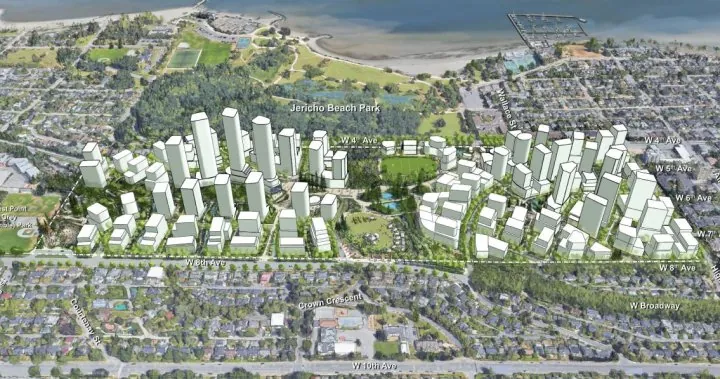
Vancouver Council Greenlights Ambitious Jericho Lands Housing Project
2025-04-22
Author: Sophie
Historic Approval for Housing Development
In a landmark decision, Vancouver city council has unanimously approved an exciting new development plan aimed at transforming the Jericho Lands into a vibrant residential hub. This First Nations-led initiative is set to create a staggering 13,000 new homes for approximately 24,000 residents in the picturesque West Point Grey neighborhood.
Massive Construction Ahead
Spanning an impressive 90 acres, the Jericho Lands site—formerly a military garrison—is poised for a significant makeover, featuring over two dozen buildings that will range from four to an eye-popping 49 stories high. This colossal project is projected to unfold over a timeline of 25 to 30 years.
First Nations Collaboration
The ambitious development stems from a collaboration between the MST Development Partnership and the Canada Lands Company, the latter being a federal Crown corporation. The MST Development Corporation represents the interests of the Musqueam Indian Band, Squamish Nation, and Tsleil-Waututh Nation, signaling a promising partnership between Indigenous communities and civic authorities.
Council Members Share Perspectives
Councillor Sarah Kirby-Yung heralded the plan as a much-needed evolution for a neighborhood that has seen minimal population growth—just one new resident—since 1996, highlighting the stark contrast to the city's overall growth. Fellow councillor Lucy Maloney expressed her joy in supporting the plan, emphasizing its potential to showcase the positive outcomes of aligning municipal efforts with First Nations' priorities.
Community Concerns and Controversies
However, the project has not come without its critics. Organized under the banner of the Jericho Coalition, opponents argue that the proposal is too expansive and conflicts with the character of the area. They advocate for an alternative vision that prioritizes low- to medium-rise structures.
A Need for Education and Understanding
Maloney voiced her disappointment over some residents' negative remarks regarding the Indigenous proponents of the project, calling for a better public understanding of First Nations' rights and the importance of this development in shaping Vancouver's future.
Future Amenities and Infrastructure Improvement
The approved plan incorporates not only residential units but also essential community facilities, including 2,600 units of social housing, expansive 12.4 hectares dedicated to parks and open spaces, 259 childcare spaces, and a future transit station contingent upon subway expansion to UBC. This multifaceted development represents a significant step forward in addressing housing needs while fostering community and sustainability.



 Brasil (PT)
 Canada (EN)
 Chile (ES)
 Česko (CS)
 대한민국 (KO)
 España (ES)
 France (FR)
 Hong Kong (EN)
 Italia (IT)
 日本 (JA)
 Magyarország (HU)
 Norge (NO)
 Polska (PL)
 Schweiz (DE)
 Singapore (EN)
 Sverige (SV)
 Suomi (FI)
 Türkiye (TR)
 الإمارات العربية المتحدة (AR)