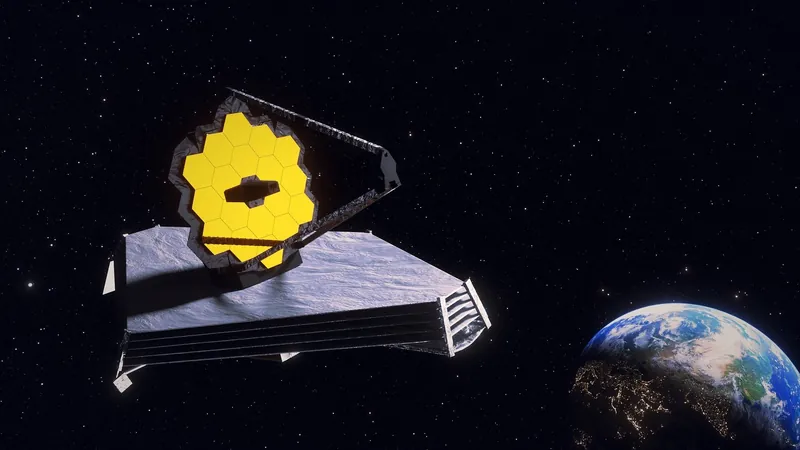
Webb Telescope's Groundbreaking Discoveries at Risk of Funding Cuts!
2025-04-23
Author: Jacques
The Webb Telescope: A Marvel of Modern Science
Despite political turmoil here on Earth, the James Webb Space Telescope (JWST) has been making waves from its perch a million miles away, revealing secrets of the universe like never before.
Revolutionizing Our Understanding of the Cosmos
In just three years since its launch, the JWST has transformed our comprehension of celestial phenomena. This $10 billion marvel employs infrared scanning technology to observe star and galaxy formation while analyzing the atmospheres of distant exoplanets. Its capabilities provide a vital supplement to the aging Hubble Space Telescope, which operates much closer to home.
Astounding Discoveries Amid Budget Uncertainties
Among its astonishing findings, Webb documented a star slowly devouring a nearby planet and tracked a high-speed asteroid heading our way—one that poses no threat to Earth. Yet, these groundbreaking revelations face a grim reality: potential funding cuts that could cripple ongoing research.
Political Storm Brewing Over NASA's Funding
Under the Trump administration, NASA has seen its top scientists removed, and the proposed budget includes draconian cuts of nearly 50% to crucial programs overseen by the Science Mission Directorate. This includes projects like the Nancy Grace Roman Space Telescope, which is on the verge of launch.
The Rippling Effects of Cuts on Scientific Progress
Even though initial budgets preserve some funding for Hubble and Webb, the overall reduction in scientific personnel threatens the operational viability of these advanced instruments. As noted by astrophysicist Daniel Holz, the success of such high-tech facilities hinges on a robust team of scientists to identify targets and interpret data.
The Broader Impact: A Scientific Backlash
These budget cuts aren’t just affecting NASA. Similar trends are emerging across various agencies responsible for crucial research, from drug safety to natural disaster predictions. In a climate where scientific truths—like climate change and public health—are increasingly politicized, the ramifications could be dire.
America's Global Standing in Science at Stake
While the U.S. once led the world in scientific research, aggressive initiatives from rivals like China and Europe threaten to upend that status. Scientists are increasingly becoming enticed by opportunities abroad, as domestic conditions grow untenable.
Maximizing Science to Prevent Future Threats
Diminished research capabilities could hinder our ability to tackle pressing global challenges, from disease management to defense innovations. The stakes have never been higher.
The Doomsday Clock: A Stark Reminder
Daniel Holz, who also oversees the Science and Security Board at the Bulletin of Atomic Scientists, highlights an alarming reality: the Doomsday Clock has never been closer to midnight, at just 89 seconds away. Factors like climate-induced resource conflicts and the potential for biotechnology mishaps worsen the scenario.
Time is Ticking—Will We Act?
As we face this critical juncture, the Bulletin remains vigilant, prepared to adjust the Doomsday Clock in response to ongoing anti-science policies. The message is clear: without adequate funding and support, humanity's grip on progress is precarious.
Stay tuned—because the fate of our scientific future might just hinge on the decisions made in the coming months.



 Brasil (PT)
 Canada (EN)
 Chile (ES)
 Česko (CS)
 대한민국 (KO)
 España (ES)
 France (FR)
 Hong Kong (EN)
 Italia (IT)
 日本 (JA)
 Magyarország (HU)
 Norge (NO)
 Polska (PL)
 Schweiz (DE)
 Singapore (EN)
 Sverige (SV)
 Suomi (FI)
 Türkiye (TR)
 الإمارات العربية المتحدة (AR)