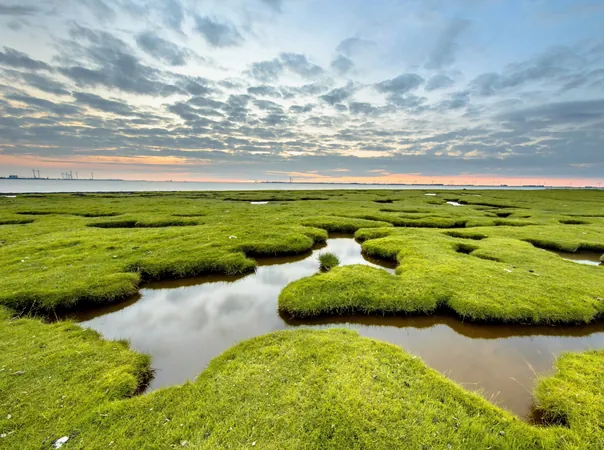
Wetlands: The Hidden Methane Hotspots Threatening Our Climate
2025-04-26
Author: Michael
As climate change intensifies, a silent battle rages beneath the murky surfaces of wetlands. Here, tiny microbes engage in a fierce fight: one group generates methane, while another works to consume it.
A recent study from the Smithsonian Environmental Research Center reveals the unsettling truth about these vital ecosystems. While wetlands are notorious for absorbing carbon dioxide (CO₂), they also stand as the planet's largest natural methane source—a gas that possesses a heat-trapping capacity significantly greater than CO₂.
The Methane Dilemma
According to the National Oceanic and Atmospheric Administration, methane accounts for 19% of global warming—a staggering figure that underscores the urgency of understanding wetland dynamics as the climate shifts. Lead author Jaehyun Lee warns, "If wetlands are major methane emitters and we lack knowledge about this, our climate change mitigation goals will be severely compromised in the future."
Within wetland soils reside two factions of microbes: methane producers and methane consumers. The latter actively convert methane into CO₂ using oxygen, effectively acting as nature's climate change mitigation team.
Revolution in Microbial Understanding
The study focused specifically on anaerobic microbes thriving in oxygen-deprived environments found in flooded wetlands. Previously thought incapable of significantly reducing methane production due to their anaerobic conditions, these microbes were underestimated.
However, data revealed otherwise: in particular wetlands, these bacteria managed to consume about 12% of methane, and in saltier terrains, this figure soared to 70%.
Warming Up the Experiment
Researchers conducted a groundbreaking experiment, the SMARTX (Salt Marsh Accretion Response to Temperature eXperiment), where they artificially warmed select areas of the wetland by more than 5°C. This study also accounted for elevated CO₂ levels, mimicking future atmospheric conditions.
As temperatures climbed, methane emissions surged but not due to weakened methane consumers. In fact, they ramped up their efforts, yet methane production outpaced their capacity—especially in plots dominated by thick sedges, where emissions skyrocketed nearly fourfold.
The Plant Factor
Plants play a crucial role in this equation. The presence of thicker plant roots enhances oxygen penetration into the soil, boosting the methane-consuming microbes' activity. Interestingly, while higher CO₂ levels did ease some of the increase in emissions, they didn't completely eliminate it.
Global Implications
This issue extends beyond individual wetlands; patterns observed in the study have been echoed in other research from 2021, indicating that as climate warms, methane-producing microbes may dominate over their methane-consuming counterparts worldwide.
Despite the alarming findings, researchers stress the ongoing necessity of wetland protection. These ecosystems not only act as natural barriers against flooding but also store vast amounts of carbon—one acre of coastal wetland can sequester more carbon than an acre of tropical rainforest.
Future Outlook
As we look ahead, policymakers are urged to gather more comprehensive data regarding methane emissions from wetlands. Understanding how these delicate microbial processes might shift under climate change is crucial for achieving global climate targets.
"It's essential to consider how climate change will affect these microbial interactions, such as the balance between methane production and consumption," Lee concludes. The full study appears in the journal Science Advances, shedding light on these hidden climate challenges.



 Brasil (PT)
 Canada (EN)
 Chile (ES)
 Česko (CS)
 대한민국 (KO)
 España (ES)
 France (FR)
 Hong Kong (EN)
 Italia (IT)
 日本 (JA)
 Magyarország (HU)
 Norge (NO)
 Polska (PL)
 Schweiz (DE)
 Singapore (EN)
 Sverige (SV)
 Suomi (FI)
 Türkiye (TR)
 الإمارات العربية المتحدة (AR)