A Gaping Hole as Large as Switzerland Emerges in Antarctic Sea Ice—And Here’s the Shocking Reason Why!
2025-04-21
Author: Lok
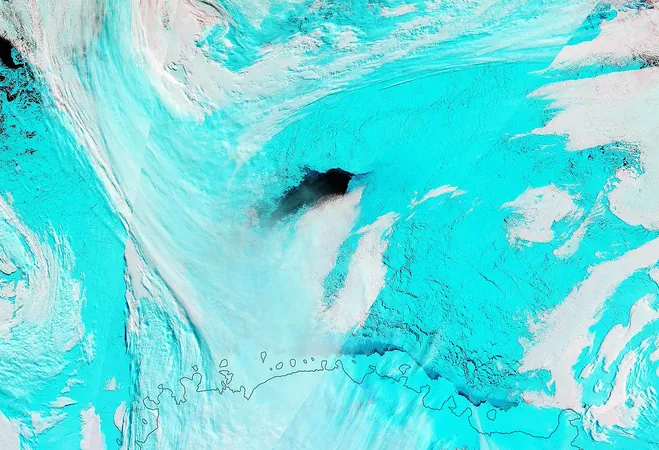
An astonishing phenomenon has unfolded in Antarctica: a massive black patch, known as a polynya, has surfaced in the winter sea ice, startling NASA scientists who observed it from space for the first time. This phenomena swelled to an incredible size—equivalent to that of Switzerland—and astonishingly, it remained open for weeks!
But how does such a colossal gap appear in the ice, situated hundreds of miles from the nearest landmass? Researchers uncovered that this striking opening lies above Maud Rise, a submerged plateau, and they've been working diligently to unravel the mystery.
What Exactly is a Polynya?
Typically, the Southern Ocean is akin to a layered cake—cold, fresh water rests delicately atop saltier, warmer layers, creating stability that prevents mixing. For a mid-ocean polynya to develop, this stable layering must be disrupted, allowing salt to seep upward, making the top layer heavier and triggering a overturning of the water column.
While similar coastal polynyas form each year due to strong winds pushing ice away from land, the high-seas variety is a rare occurrence. The towering Maud Rise may play a pivotal role by manipulating currents and creating eddies that trap water in tight spirals.
Unraveling the Mystique of Maud Rise
Historical data from the 1970s suggest that this isn’t the first time Maud Rise has hosted a polynya. Between 1974 and 1976, a larger gap persisted there during winter, observed by the first remote-sensing satellites.
Although scientists expected this winter occurrence to become regular, it has only been sporadic since. "2017 marked the first time we’ve recorded a polynya this large and long-lasting in the Weddell Sea since the 1970s," explains Aditya Narayanan, from the University of Southampton.
Key Players: Salt, Storms, and Ocean Currents
During those winters, the rotating Weddell Gyre accelerated, bringing warm, salty water closer to the ice's underside, softening it. However, this process should have resulted in a freshening of the surface, halting further mixing.
"This upwelling explains some melting, but the surface freshening should have stopped it altogether," adds Fabien Roquet, co-author and professor of Physical Oceanography. Therefore, another source of salt must be contributing to the ongoing polynya.
Extratropical storms played a critical role, pushing sea ice away and transporting salty water to the Maud Rise. Additionally, atmospheric rivers—massive plumes of moist air—brought warmth, aiding the breakdown of the water column.
The Missing Link: Ekman Transport
The final component of this complex scenario involves a physical phenomenon known as Ekman transport. This process occurs when the wind interacts with ocean currents, causing a 90-degree deflection of surface flow due to the Earth's rotation.
According to co-author Alberto Naveira Garabato, this led to a greater influx of salty water to the critical area where the 2017 polynya opened up, invigorating the mixing of heat and salt within the surface waters.
By late September of that year, the polynya had released heat at a rate over twenty times higher than the standard output under intact ice before it closed again.
The Global Implications of Polynyas
While a hole in the Antarctic ice may seem localized, its effects radiate far beyond. Professor Sarah Gille from UCSD remarks, "Polynyas can influence ocean movements and the distribution of heat—affecting waters globally."
Deep convection not only pulls carbon-rich waters upward, releasing CO₂ but also sends oxygen-rich brine sliding along the ocean floor, ultimately influencing global currents.
What Lies Ahead?
As the world warms, the unique Maud Rise conditions could shift, significantly affecting the occurrence of such phenomena. Professor Gille noted, "For the first time since the 1970s, sea ice coverage in the Southern Ocean has demonstrated a negative trend since 2016. This rise of warm, salty water is now thinning ice around Antarctica’s edges."
Scientists are now closely monitoring the upcoming winters. Regardless of whether the polynya returns, its story illustrates how the icy realms of our planet can still reveal astonishing surprises—and the implications for the broader climate system are far-reaching!
This compelling research was published in the journal Science Advances.

 Brasil (PT)
 Canada (EN)
 Chile (ES)
 Česko (CS)
 대한민국 (KO)
 España (ES)
 France (FR)
 Hong Kong (EN)
 Italia (IT)
 日本 (JA)
 Magyarország (HU)
 Norge (NO)
 Polska (PL)
 Schweiz (DE)
 Singapore (EN)
 Sverige (SV)
 Suomi (FI)
 Türkiye (TR)
 الإمارات العربية المتحدة (AR)