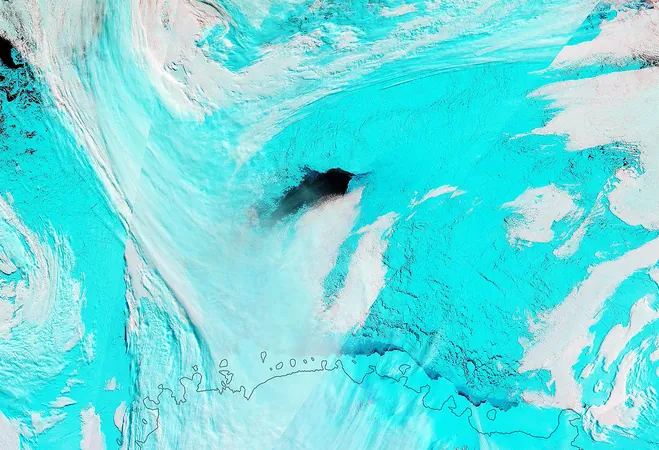
A Gaping Hole the Size of Switzerland Emerges in Antarctica's Sea Ice—Here's What We Discovered!
2025-04-23
Author: Ken Lee
When scientists first spotted an enormous, black area of open water in Antarctica’s sea ice—a phenomenon known as a polynya—they were left astonished. This massive hole, roughly the size of Switzerland, remained unfrozen for weeks, raising crucial questions about its formation.
What is a Polynya?
Polynyas are significant openings in sea ice that can occur when layers of ocean water destabilize. Typically, the Southern Ocean has a stratified structure, with a lighter layer of cold freshwater floating atop saltier, warmer water. For a polynya to form, this layered configuration must be disrupted. Salt must be introduced to the surface layer, making it denser and causing it to sink. This initiates convection, resulting in the top layer fracturing and releasing heat—essentially allowing the ocean to 'breathe' gases.
The Role of Maud Rise
Researchers soon connected this extraordinary event to the Maud Rise, a submerged plateau that alters ocean currents. Historical data reveals that a similarly colossal polynya existed over Maud Rise in the 1970s, drawing attention to this area’s potential for such openings.
Unpacking the Mystery: Salt and Storms
During the 2017 events, the Weddell Gyre—a powerful ocean current—intensified. It drew warm, salty water closer to the ice surface, creating a paradox: the freshwater from melting ice should have stabilized the layers and prevented mixing. Yet persistent extratropical storms disrupted this balance, pushing ice away and bringing briny water to the surface.
The Science Behind the Flow
Another factor was identified: Ekman transport, a phenomenon where the Earth's rotation deflects ocean surface flow. This helped direct the salt-laden water precisely where the polynya formed, driving heat and salt upward and intensifying the melting process.
A Wider Impact
While this hole may seem localized, its effects resonate globally. Studies indicate that polynyas can influence ocean currents and heat distribution for years after their formation. They play an essential role in moving carbon-rich waters upward, where they can release CO₂ and push oxygen-poor brine to the ocean floor.
Looking Ahead: Climate Implications
The emergence of this massive polynya suggests potential long-term changes in Antarctic sea ice patterns. Climate change is already altering wind conditions, which could affect the frequency of such events. With ongoing observations, scientists are eager to see if more polynyas develop in the coming winters.
This remarkable phenomenon reveals that even the coldest, most remote areas of our planet are dynamic and interconnected. As changes in Antarctica reverberate across the globe, the lessons learned from this polynya will be pivotal in understanding our changing climate.

 Brasil (PT)
 Canada (EN)
 Chile (ES)
 Česko (CS)
 대한민국 (KO)
 España (ES)
 France (FR)
 Hong Kong (EN)
 Italia (IT)
 日本 (JA)
 Magyarország (HU)
 Norge (NO)
 Polska (PL)
 Schweiz (DE)
 Singapore (EN)
 Sverige (SV)
 Suomi (FI)
 Türkiye (TR)
 الإمارات العربية المتحدة (AR)