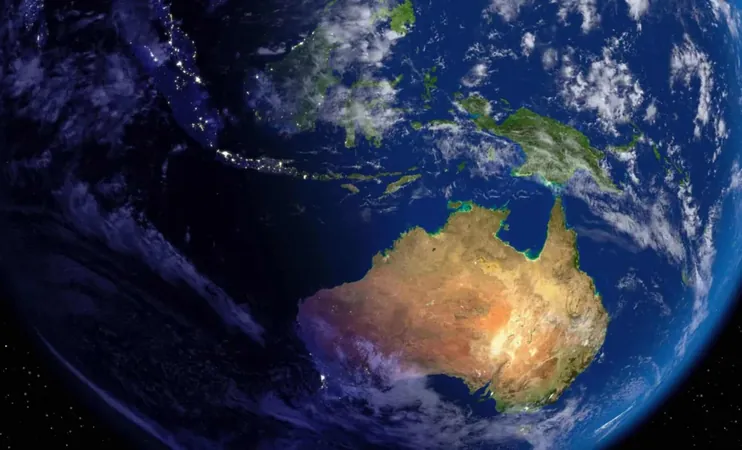
Australia and Asia Are on a Collision Course—and It’s Happening Sooner Than We Thought!
2025-04-19
Author: Ken Lee
The Great Drift: Australia’s Race Towards Asia
Australia is slowly but surely barreling towards Asia—and it’s not just a matter of slow geological drift. According to Professor Zheng-Xiang Li from Curtin University, this movement is not only transforming our planet’s geography but is also disrupting vital ecosystems and challenging human technology. His team has meticulously tracked the Indo-Australian Plate, revealing that it’s pushing upward at an astonishing rate of 7 centimeters per year—about the same speed at which our fingernails grow.
The Undeniable Motion of Continents
While most people conjure images of steadfast landmasses, the reality is every continent is perpetually on the move, floating atop colossal tectonic plates. Among them, Australia is currently the swiftest, advancing northward at a rate that’s surprising everyone. Professor Li explains, “Australia is moving northwards 7 centimeters every year towards Asia.” This is not just a slow drift; it’s a momentum that's already impacting life on our planet.
Seismic Signals: The Looming Collision Zone
The evidence of Australia’s inexorable movement can be seen in the increasing seismic activity along its northern borders. As the continent collides with the tectonic plates of neighboring regions like Indonesia and Papua New Guinea, stress accumulates along fault lines, triggering earthquakes, tsunamis, and subtle shifts in the Earth's crust. These tremors are just the beginning, prelude to a future of new mountain ranges and potential geological upheaval.
A Planetary Cycle: The Return of Supercontinents
Scientists propose that the Earth operates on a supercontinent cycle—a cycle in which continents periodically drift away from each other and then recombine into massive landmasses over eons. Professor Li suggests that when Australia fully merges with Asia, a new supercontinent, dubbed Amasia, could emerge in the northern hemisphere. However, this union won’t be gentle; it may trigger a terrifying 'ring of fire' filled with volcanic eruptions and seismic activity.
A Biodiversity Crisis Awaits
As Australia relocates, it drags its unique ecosystems into an uncertain future. For tens of millions of years, Australia’s geographical isolation has fostered an array of distinctive species—from kangaroos to koalas. Once it collides with Asia, this isolation will dissolve, exposing native species to competitive pressures from diverse tropical species. Conservationists signal a looming biodiversity crisis that could result in widespread extinctions, depicting a dire future for Australia’s distinct wildlife.
GPS Gone Haywire: The Tech Trouble Ahead
Australia's continental drift is already wreaking havoc on modern technology. Recent studies disclosed that the country’s GPS coordinates were misaligned by nearly 1.5 meters due to tectonic shifts. While that may seem minor, discrepancies like this pose serious challenges for autonomous vehicles, surveying technologies, and air traffic management. This drift necessitated a manual adjustment of Australia’s official geographic coordinates, emphasizing the urgent need for regular updates in navigation systems.
Climate Change, Ocean Currents, and the Future
As Australia inches closer to the tropics, the implications for climate and ocean currents could be monumental. We may see significant shifts in monsoon patterns and climate zones as Australia moves into warmer waters. Just as the Great Barrier Reef flourished in these conditions, future tectonic shifts could give birth to new coral systems, simultaneously threatening existing ones under increasing environmental pressures.
In Summary: The Earth is Moving, and So Are We
The drift of Australia towards Asia illustrates a dramatic, ongoing transformation of our planet—one that promises both dangers and opportunities. While the collision might be millions of years away, the early tremors are already felt across continents, ecosystems, and technologies, urging humanity to pay attention to the dynamic forces that shape our world.

 Brasil (PT)
 Canada (EN)
 Chile (ES)
 Česko (CS)
 대한민국 (KO)
 España (ES)
 France (FR)
 Hong Kong (EN)
 Italia (IT)
 日本 (JA)
 Magyarország (HU)
 Norge (NO)
 Polska (PL)
 Schweiz (DE)
 Singapore (EN)
 Sverige (SV)
 Suomi (FI)
 Türkiye (TR)
 الإمارات العربية المتحدة (AR)