Bizarre Deep-Sea Discovery: Fish with Parasite 'Pig Tails' Revealed!
2025-04-23
Author: Ying
A Shocking Encounter Beneath the Waves
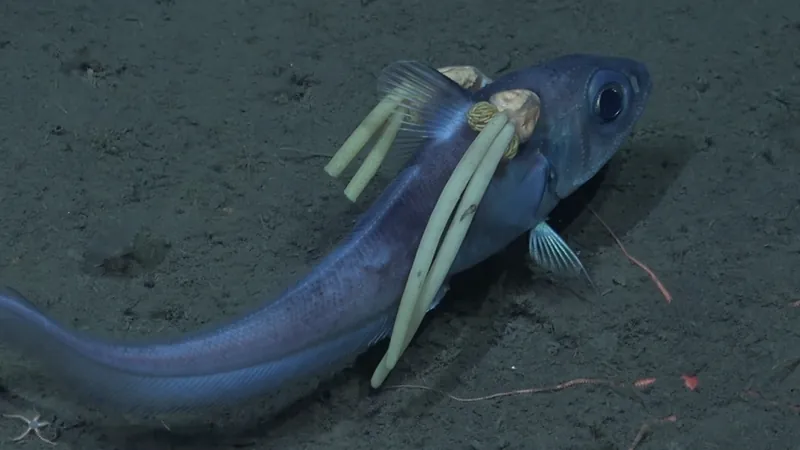
In an astonishing new video released by the Schmidt Ocean Institute, deep-sea explorers captured footage of a rattail fish sporting what can only be described as parasite 'pig tails.' These shocking visuals reveal two bloodsucking copepods clinging to the fish's head, their long egg sacs trailing behind, giving a bizarre appearance that resembles playful pigtails.
Meet the Bloodsucking Copepods
These remarkable copepods, known scientifically as Lophoura szidati, have perfected the art of parasitism, feeding on the blood and bodily fluids of their fish host using specialized mouthparts embedded in the fish’s muscle tissue. Renowned evolutionary biologist James Bernot from the Smithsonian National Museum of Natural History shared insights into these fascinating creatures, emphasizing their unique feeding mechanism.
A Dive into the Deep: Where This Discovery Happened
Captured at a staggering depth of 1,604 feet during an expedition to explore the South Sandwich Islands, a series of volcanic islets in the South Atlantic Ocean, this footage shines a light on the mysterious biodiversity lurking beneath the icy waves. Rattail fish, or grenadiers, are known for their distinctive large heads and slender tails, thriving in cold waters across the Atlantic and Southern Oceans.
A Deep-Sea Parasitic Mystery
Knowledge about deep-sea fish parasites, especially in Antarctic regions, is limited. However, L. szidati stands out as one of the most prevalent parasites afflicting the Macrourus species in this icy habitat. As mesoparasites, they reside both inside and outside the fish, with parts of their bodies protruding while their heads remain embedded, firmly attached to their host.
Life Cycle of a Deep-Sea Parasite
Each copepod comes armed with egg sacs containing hundreds of eggs, showcasing their surprising parental care—an impressive feat among invertebrates. Bernot noted that as these parasites grow and metamorphose, they gradually anchor themselves deeper into the fish's skin.
The Long-Lasting Bond
Details about the lifespan of these tiny parasitic hunters remain shrouded in mystery. However, scientists suggest that they could live for several months as they develop from microscopic larvae to fully grown parasites embedded in their hosts. Even after death, remnants of the copepod's head can linger in the fish for years, marking a permanent connection.
Wrapping Up the Fascination of the Deep
This bizarre encounter not only highlights the incredible resilience of life in extreme environments but also raises questions about the complex relationships within underwater ecosystems. Stay tuned as researchers continue to unveil the secrets of the deep sea!


 Brasil (PT)
 Canada (EN)
 Chile (ES)
 Česko (CS)
 대한민국 (KO)
 España (ES)
 France (FR)
 Hong Kong (EN)
 Italia (IT)
 日本 (JA)
 Magyarország (HU)
 Norge (NO)
 Polska (PL)
 Schweiz (DE)
 Singapore (EN)
 Sverige (SV)
 Suomi (FI)
 Türkiye (TR)
 الإمارات العربية المتحدة (AR)