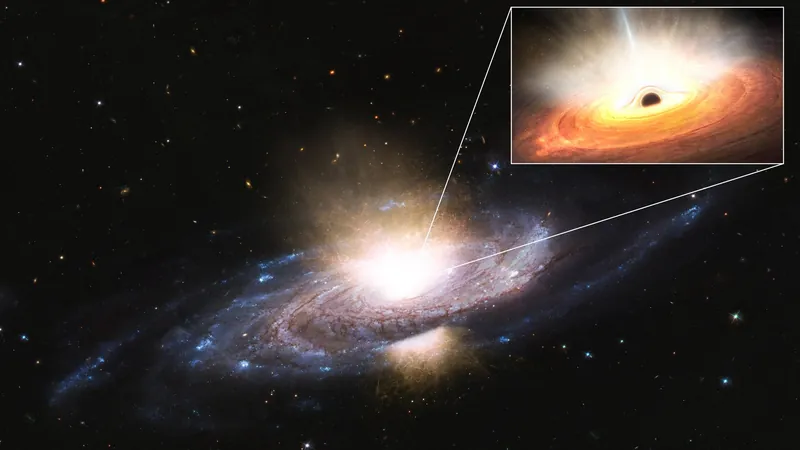
Black Hole Myth Busted: James Webb Telescope Unveils the Real Story Behind 'Super-Fast' LID-568
2025-04-25
Author: Yan
A Black Hole Thought to Defy Physics is Just Ordinary
The cosmos continues to astonish, but it seems not every astronomical sensation lives up to the hype. The James Webb Space Telescope (JWST) recently unveiled the truth behind LID-568, a black hole once thought to be consuming matter at a staggering rate—40 times what physics says is possible.
Initial Observations Stunned Astronomers
Back in November 2024, astronomers excitedly announced they had found LID-568, a black hole from an epoch just 1.5 billion years post-Big Bang. Its supposed super-speedy appetite suggested that it shouldn’t have existed given the short period to have amassed such colossal mass. Scientists speculated this black hole could provide clues on how supermassive black holes formed in the early universe.
Reassessing the Data: Dusty Miscalculations
New research, published in The Astrophysical Journal on April 4, turns that thrilling narrative on its head. Upon revisiting JWST's observations, researchers discovered that LID-568’s accretion rate is actually quite ordinary. Dust interference had skewed the original calculations, leading to an inflated image of the black hole's voracity.
Understanding Black Hole Feeding Rates
In the world of black holes, there’s a fascinating limit called the Eddington limit, which dictates how much mass a black hole can consume. This depends on its mass: the greater the mass, the higher the limit. Normally, when radiation pressure surmounts gravitational pull, black holes stop devouring matter. However, super-Eddington accretion occurs under certain circumstances, warranting a compelling reason for LID-568’s initial excitement.
New Findings Reveal the Truth
After accounting for dust, astronomers established that LID-568's mass is actually around a billion solar masses—40 times smaller than previously thought. By measuring infrared light from the gas surrounding the black hole, researchers avoided the heavy absorption effects of dust that plagued earlier observations.
Conclusion: Just Another Cosmic Mystery?
This calibration sheds light on the miscalculations astronomers have faced with distant galaxies, emphasizing the importance of accurate dust correction. LID-568's feeding habits cannot be attributed to the early growth of supermassive black holes, but merely to environmental obscurity. The cosmos is still a mysterious place, but this case serves as a reminder: not all that glitters in the depths of space is gold!
 Brasil (PT)
 Canada (EN)
 Chile (ES)
 Česko (CS)
 대한민국 (KO)
 España (ES)
 France (FR)
 Hong Kong (EN)
 Italia (IT)
 日本 (JA)
 Magyarország (HU)
 Norge (NO)
 Polska (PL)
 Schweiz (DE)
 Singapore (EN)
 Sverige (SV)
 Suomi (FI)
 Türkiye (TR)
 الإمارات العربية المتحدة (AR)