Boeing's Bumpy Road: Smaller Losses Amid Trade War Tensions
2025-04-23
Author: Ling
Boeing Shows Signs of Recovery but Trade War Clouds the Horizon
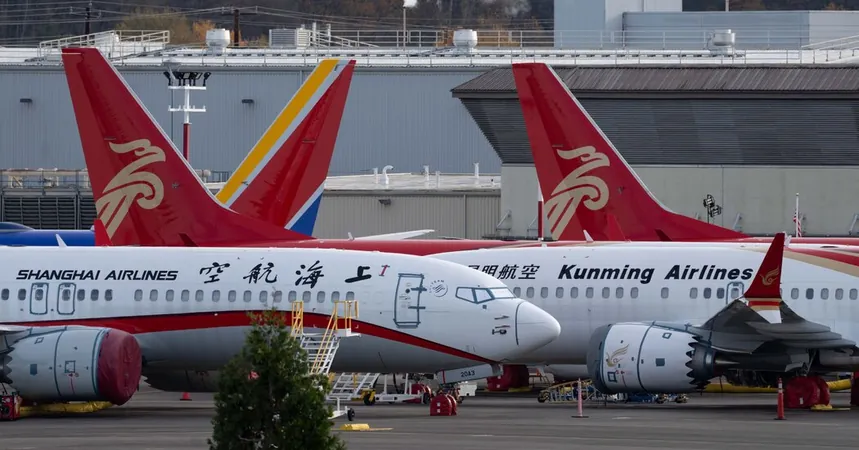
Boeing has reported a smaller loss of $31 million in the first quarter of this year, a significant improvement from the staggering $350 million loss during the same period last year. The company is cautiously optimistic as it aims to increase production of its commercial aircraft, moving toward stability after a series of quality control issues.
Production Challenges and Setbacks
The latest crisis for Boeing ignited when a poorly installed panel detached from a new aircraft mid-flight earlier this year. Additionally, a two-month strike in fall 2023 delayed production of the 737 Max, their most popular model. Despite these setbacks, Boeing managed to deliver 130 planes this quarter, up from just 83 last year. The firm also secured a lucrative contract to manufacture the Air Force's latest fighter jet, the F-47.
Booming Revenue But Mixed Signals in Divisions
Boeing's revenue soared to $19.5 billion, reflecting an 18% increase from the previous year. Notably, the commercial division saw a remarkable 75% rise in revenue. In contrast, the defense segment experienced a 9% decline, while service sales remained flat, which has historically contributed to higher profit margins.
Selling Digital Businesses for Financial Flexibility
In a strategic move to refocus on its core mission of aircraft manufacturing, Boeing announced the sale of several digital businesses for $10.5 billion to Thoma Bravo, a private equity firm. Analysts believe this decision will strengthen Boeing's financial position and ease cash flow challenges.
Production Goals and Regulatory Hurdles
Boeing aims to ramp up production of the 737 Max from the low 20s per month to 38 in the coming months, pending approval from the Federal Aviation Administration (FAA). Meanwhile, production of the 787 Dreamliner is stabilizing at five units per month, with plans to increase that to seven.
Trade War Woes Could Derail Progress
However, Boeing's recovery trajectory faces challenges from ongoing trade tensions and tariffs imposed by the Trump administration, particularly a 10% tariff on imports and even higher rates on Chinese goods. Reports indicate that China has halted new Boeing aircraft purchases, marking a critical risk for the manufacturer, especially as China represents a significant market for aircraft.
The Competitive Landscape: Comac and Future Prospects
While China is developing its aerospace sector, led by homegrown manufacturer Comac, experts agree that it will take years for China to significantly ramp up production capabilities. Boeing had projected a demand for around 8,800 new planes in China over the next two decades, positioning it for potential growth if trade relations improve.
The Cultural Shift Inside Boeing
CEO Kelly Ortberg is determined to transform Boeing's culture, addressing the shortcuts that contributed to past troubles. In a recent employee survey, 67% expressed pride in working at Boeing, a sharp decline from 91% in 2013. This shift is part of Ortberg's broader vision for a revitalized Boeing.
Conclusion: A Turning Point or Ongoing Turmoil?
As Boeing grapples with improving financial metrics while navigating turbulent trade relations, the company's path forward remains uncertain. Will it successfully stabilize its operations and overcome external pressures? Only time will tell.


 Brasil (PT)
 Canada (EN)
 Chile (ES)
 Česko (CS)
 대한민국 (KO)
 España (ES)
 France (FR)
 Hong Kong (EN)
 Italia (IT)
 日本 (JA)
 Magyarország (HU)
 Norge (NO)
 Polska (PL)
 Schweiz (DE)
 Singapore (EN)
 Sverige (SV)
 Suomi (FI)
 Türkiye (TR)
 الإمارات العربية المتحدة (AR)