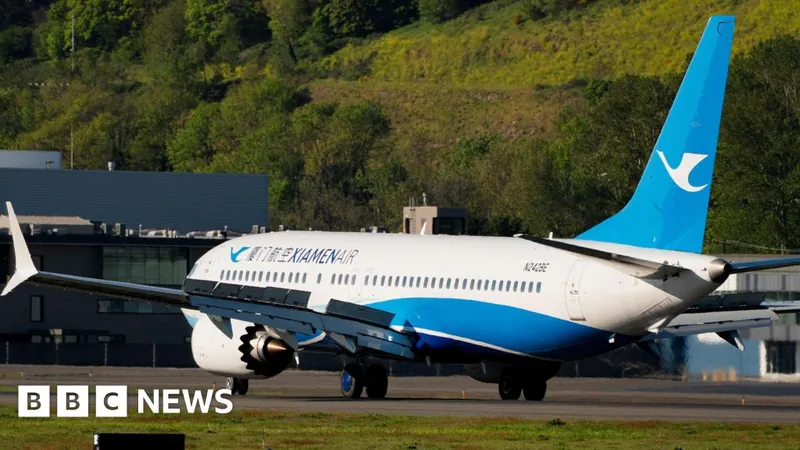
China Strikes Back: Boeing Planes Rejected Amid Trade War
2025-04-23
Author: Jia
China's Bold Move Against Boeing
In a striking development in the ongoing trade saga, China has returned planes ordered from Boeing in direct retaliation for tariffs imposed during the Trump administration. Boeing's CEO, Kelly Ortberg, revealed that two aircraft have already been sent back, with more on the way.
Tariff Tensions Escalate
The backdrop to this move is the intensified trade conflict between the United States and China. With the U.S. levying a staggering 145% tariff on Chinese imports, Beijing retaliated with a 125% tax on U.S. goods. Ortberg noted that Boeing faced significant challenges, as another 50 planes originally scheduled for delivery to China are now off the table.
Trump's Optimism vs. Aviation Realities
Despite President Trump's optimistic remarks in the Oval Office regarding potential improvements in trade relations—suggesting that tariffs might eventually decrease—Boeing's leadership emphasizes the stark reality: China has halted the reception of new aircraft amid these tariffs. This is particularly concerning for Boeing, which relies on international markets for nearly 70% of its commercial aircraft sales.
Plans to Adapt Amidst Market Shakeup
In light of this setback, Boeing is exploring options to re-market 41 finished planes to other buyers, as demand from other airlines remains robust. There are an additional nine planes not yet in production that Boeing intends to assign to alternative customers.
Daily Engagement with Washington
Ortberg indicated that dialogue with the Trump administration is constant, stating, "Not a day goes by without discussions with cabinet members or the President himself about the trade war with China." He expressed hope for fruitful negotiations in the near future.
Potential for a Game-Changing Deal
Treasure Secretary Scott Bessent shared insights at an IMF conference, revealing that a significant opportunity for a broad trade deal could arise if both nations can address manufacturing dependency.
Impact on Boeing’s Supply Chain
Further compounding the concerns, Ortberg highlighted that other parts of Boeing's supply chain, particularly in Japan and Italy, are now vulnerable to tariffs, with universal taxes of around 10% being implemented.
Boeing's Financial Outlook
Despite these challenges, Boeing reported smaller losses in the first quarter of this year as production and delivery rates improve. Following a tumultuous 2024, which saw production halts and a significant strike by American factory workers, the company aims to boost output of its 737 MAX jets to 38 per month by 2025.

 Brasil (PT)
 Canada (EN)
 Chile (ES)
 Česko (CS)
 대한민국 (KO)
 España (ES)
 France (FR)
 Hong Kong (EN)
 Italia (IT)
 日本 (JA)
 Magyarország (HU)
 Norge (NO)
 Polska (PL)
 Schweiz (DE)
 Singapore (EN)
 Sverige (SV)
 Suomi (FI)
 Türkiye (TR)
 الإمارات العربية المتحدة (AR)