China Unites with the US in Cosmic Discovery: A Rare Exchange of Moon Rocks!
2025-04-25
Author: Ling
A Surprising Collaboration Amid Tensions
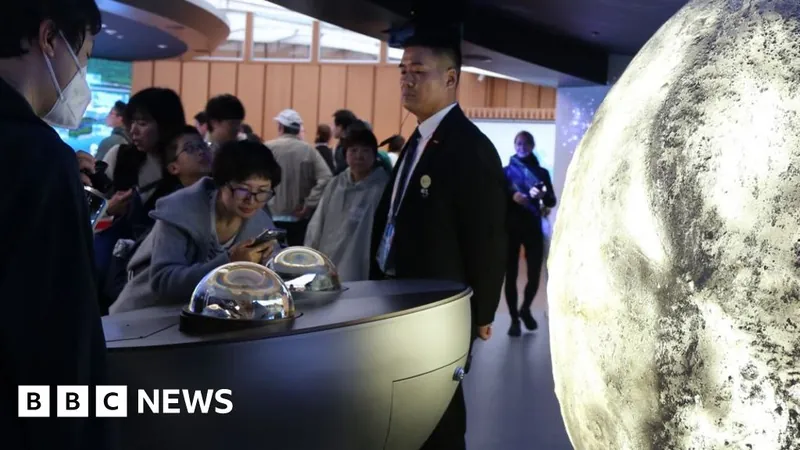
In an unexpected twist amidst ongoing trade tensions, China has opened its doors to international scientific collaboration by allowing researchers from six countries, including the United States, to study precious lunar rocks. This remarkable initiative follows China's successful Chang'e-5 mission in 2020, where the country collected samples from the Moon's surface.
NASA's Two Institutions Join the Lunar Quest
Officially announced by the China National Space Administration (CNSA), this groundbreaking opportunity grants two NASA-funded institutions access to the rare moon samples. CNSA chief Shan Zhongde declared these samples as "a shared treasure for all humanity," showcasing a spirit of cooperation that transcends political barriers.
Navigating Restrictions: A Diplomatic Dance
Despite the potential for scientific collaboration, U.S. lawmakers have imposed strict restrictions that hinder NASA's ability to work with Chinese entities. Under a 2011 law, NASA is prohibited from collaboration with China unless specifically authorized by Congress. However, experts like former Space Policy Institute director John Logsdon emphasize that the exchange of moon rocks focuses solely on scientific inquiry and bears no military significance.
Trade War Shadows: Beyond the Rocks
While the U.S. and China engage in a bitter trade war—marked by hefty tariffs up to 245% on U.S. goods and retaliatory tariffs at 125% from Beijing—the world watches as this spirit of teamwork in lunar exploration unfolds. In fact, President Trump previously hinted at easing the trade conflict, but the reality remains fraught with complexity and denial of negotiations from the Chinese side.
The Unique Chang'e-5 Samples
What makes the Chang'e-5 samples particularly intriguing is their geological youth; they are estimated to be a billion years younger than those retrieved during the Apollo missions. This extraordinary finding suggests that volcanic activity on the Moon occurred more recently than previously believed, unlocking new mysteries of our celestial neighbor.
Expanding the Circle of Cosmic Friends
The CNSA recently announced a call for applications for research on the Chang'e-5 samples, attracting bids from institutions not just in the U.S. but also in France, Germany, Japan, Pakistan, and the UK. Shan expressed an optimistic vision for the future, stating, "I believe China's circle of friends in space will continue to grow," and emphasizing the importance of international cooperation as part of the broader Belt and Road Initiative.
Towards a Collaborative Cosmic Future
As we stand on the brink of a new era in space exploration, this exchange of moon rocks serves as a beacon of hope, suggesting that even in times of political unrest, collaborative endeavors in science can pave the path forward. Will this set a precedent for future partnerships between nations in the endless pursuit of knowledge about the cosmos?
 Brasil (PT)
 Canada (EN)
 Chile (ES)
 Česko (CS)
 대한민국 (KO)
 España (ES)
 France (FR)
 Hong Kong (EN)
 Italia (IT)
 日本 (JA)
 Magyarország (HU)
 Norge (NO)
 Polska (PL)
 Schweiz (DE)
 Singapore (EN)
 Sverige (SV)
 Suomi (FI)
 Türkiye (TR)
 الإمارات العربية المتحدة (AR)