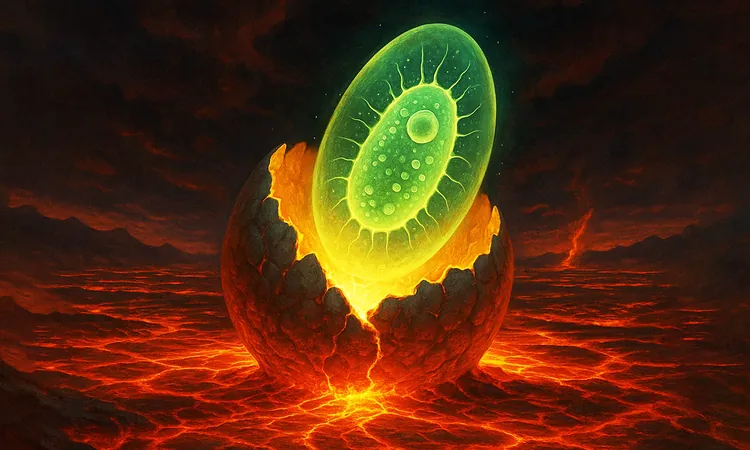
Discovering Our Ancient Ancestor: The Surprising Source of All Life on Earth
2025-04-18
Author: Chun
One DNA Code for All Life on Earth
Imagine every plant leaf, eagle feather, and speck of pond scum all spelling existence with the same four letters of DNA. That's the marvel of life! This genetic uniformity has scientists enthralled, leading them to explore a provocative question: who authored the original blueprint for life?
Meet LUCA: The Last Universal Common Ancestor
Enter LUCA, or the Last Universal Common Ancestor, a primordial organism that stands at the root of every living thing. This finding suggests that life is linked by a single genetic code—a fact implying more than mere happenstance.
Dr. Edmund Moody from the University of Bristol, a lead author in the recent study, delves into the tangled web of gene evolution and species genealogy, using a detailed analysis of thousands of genomes to trace back the origins.
Decoding LUCA's Genetic Toolkit
Gone are the days when estimates of LUCA's genetic components ranged widely from 80 to over 1,500 genes. Now, researchers propose that LUCA boasted about 2,600 genes, akin to those found in today’s modern bacteria.
These genes included essential functions like membrane pumps, DNA repair, and even a unique metabolic pathway known as the Wood–Ljungdahl pathway—turning carbon dioxide and hydrogen into energy. This paints LUCA not as a simple life form, but as a robust and adaptable organism.
A Glimpse of Early Earth
This ancient ancestor thrived around 4.2 billion years ago, a mere few hundred million years after Earth itself formed. In an environment rife with asteroid impacts and volcanic activity, LUCA likely found refuge in hydrothermal vents—warm, mineral-laden oases ripe for cellular innovation.
The Arms Race with Viruses
Intriguingly, LUCA was not merely surviving but thriving and engaging in a biological arms race. It appears to have possessed an early immune system, utilizing mechanisms resembling today’s CRISPR technology to fend off viruses that emerged as soon as cells did.
A Collaborative Microbial Ecosystem
But LUCA wasn’t alone! The waste it produced likely fostered a recycling ecosystem, feeding other microbes that created a symbiotic relationship. This intricate dance of give and take might have stabilized early Earth’s chemistry long before life as we know it took off.
Why LUCA Matters for the Future
The insights from this study are vital for our understanding of life's evolution. Researchers are keen to apply these findings to explore the lesser-known Archaea and their unique traits. The multidisciplinary collaboration involved in this research highlights the richness that can emerge when different fields unite.
A Bright Future in the Quest for Life Beyond Earth
This revelation about LUCA opens up exciting possibilities—not just for Earth, but for the universe. It raises the tantalizing question: If life didn't just tiptoe onto Earth but rather sprinted into existence, could other Earth-like planets be harboring their own bustling worlds of life?
What's Next in the Exploration of Early Life?
As technology to sequence genomes evolves, scientists will deepen their investigations—unearthing ancient genes and searching for viral remnants embedded in DNA. Future drilling at untouched hydrothermal vents may reveal communities echoing that primordial life, forging stronger links between our geological roots and genetic heritage.
In summary, LUCA wasn’t a mere ghost of early life; it was a pioneering organism equipped with the tools for survival and innovation. Every living being today carries a spark from that 4-billion-year-old ancestral fire.
 Brasil (PT)
 Canada (EN)
 Chile (ES)
 Česko (CS)
 대한민국 (KO)
 España (ES)
 France (FR)
 Hong Kong (EN)
 Italia (IT)
 日本 (JA)
 Magyarország (HU)
 Norge (NO)
 Polska (PL)
 Schweiz (DE)
 Singapore (EN)
 Sverige (SV)
 Suomi (FI)
 Türkiye (TR)
 الإمارات العربية المتحدة (AR)