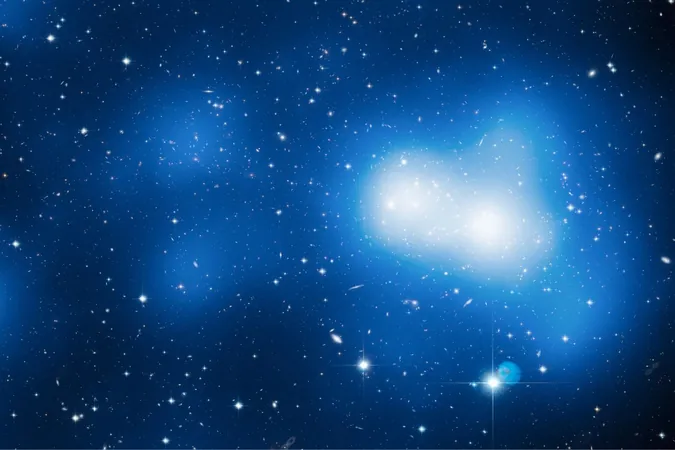
Discovering the Cosmic Colossus: The Universe's Largest Structure Just Got Even Bigger!
2025-04-21
Author: Ken Lee
Think the cosmic web couldn’t get any more complex? A groundbreaking new study suggests otherwise! Astrophysicists have harnessed the power of gamma-ray bursts—those dazzling flashes of energy from the farthest corners of the universe—to uncover that the vast Hercules–Corona Borealis Great Wall, previously deemed the largest known structure in the cosmos, is even more colossal than we imagined.
This mind-boggling superstructure, which consists of galaxy groups and clusters, is estimated to stretch a staggering 10 billion light-years! That’s right, it’s larger than the earlier estimate of about 9.8 billion light-years, sending shockwaves through existing cosmological theories.
In a pioneering study by a joint team of Hungarian and American researchers led by István Horváth from Budapest's University of Public Service, they analyzed 542 gamma-ray bursts with known redshifts. Essentially, this means they’ve pinpointed their distances, providing crucial cosmic navigational markers. Think of gamma-ray bursts as the universe’s ultimate flares—these astronomical explosions can temporarily outshine whole galaxies! When these bursts start clustering in specific regions, they raise fascinating questions about the universe.
By examining the distribution of these bursts, the team discovered that the Hercules-Corona Borealis Great Wall extends across an extensive range of redshifts from z = 0.33 to z = 2.43, spanning an unimaginable expanse through both space and time, reaching billions of light-years!
And before you dismiss it as a mere glitch or telescope error, the researchers diligently ruled out any statistical anomalies or biases. But here's the catch: the current cosmological principle suggests that the universe should be mostly uniform when viewed on large scales. Experts had set an upper limit for such grand structures at around 370 megaparsecs (or about 1.2 billion light-years)—far surpassed by this new finding.
Forget about the Sloan Great Wall or the Giant Quasar Group; the Hercules-Corona Borealis Great Wall dwarfs them all. This superstructure isn’t merely a patch of sky filled with bursts; it’s a dense assembly of galaxies, stars, and dark matter bound together by the force of gravity.
Even more intriguing, these luminous gamma bursts might uncover features invisible to conventional surveys, revealing patterns of star formation linked to the deaths of massive stars.
If the research team’s conclusions hold true, we might need to reevaluate our understanding of how structures of this magnitude can exist in the cosmos. It’s possible we’re facing an oversight in our comprehension of cosmic evolution—or perhaps a bit of both!
The next time you gaze at the night sky and ponder your place in the universe, remember: you’re not just small—you’re practically minuscule compared to a cosmic ‘wall’ that trivializes the grand scale of existence!


 Brasil (PT)
 Canada (EN)
 Chile (ES)
 Česko (CS)
 대한민국 (KO)
 España (ES)
 France (FR)
 Hong Kong (EN)
 Italia (IT)
 日本 (JA)
 Magyarország (HU)
 Norge (NO)
 Polska (PL)
 Schweiz (DE)
 Singapore (EN)
 Sverige (SV)
 Suomi (FI)
 Türkiye (TR)
 الإمارات العربية المتحدة (AR)