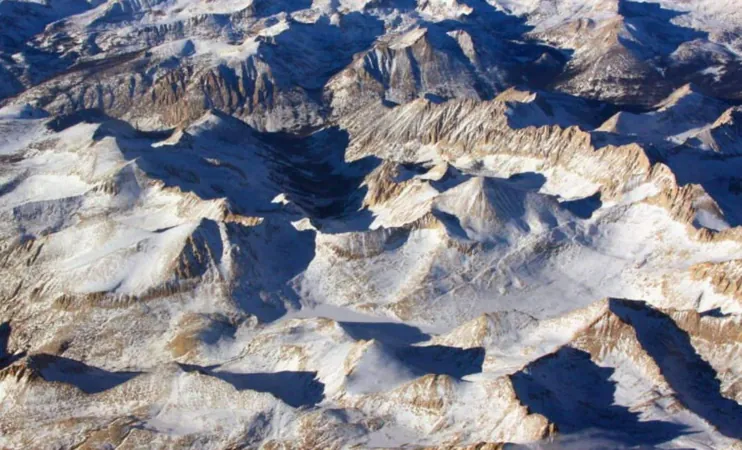
Earth's Crust is Peeling Apart Under Sierra Nevada – What It Means for California
2025-04-22
Author: Jia
A Troubling Discovery Beneath Sierra Nevada
Seismologists monitoring quake activity in California have stumbled upon a shocking geological event deep within the Sierra Nevada mountain range. This phenomenon, known as lithospheric foundering, involves chunks of the Earth's outer crust detaching and sinking into the mantle, and recent findings suggest it's actively happening right now.
Unraveling the Mystery of Deep Earthquakes
The investigation kicked off when Deborah Kilb, a seismologist from the Scripps Institution of Oceanography, observed unusual earthquake patterns over the years. In central Sierra Nevada, quakes were striking at depths ranging from 20 to 40 kilometers, much deeper than the usual 10 to 18 kilometers seen in other parts of California.
Collaboration with Vera Schulte-Pelkum, a geophysicist from the University of Colorado Boulder, revealed rock deformations in the same area, laying the groundwork for a deeper exploration of this unusual geological behavior.
The Shocking Evidence of Crustal Peeling
Utilizing advanced seismic imaging techniques, the researchers successfully mapped a compelling structure beneath the Sierra Nevada. Their findings confirmed the lithosphere is indeed peeling away, a process that had previously been merely speculative for this region.
Published in the journal Geophysical Research Letters, the research corroborated earlier beliefs that the dense lower layer of the lithosphere separated millions of years ago in the southern Sierra Nevada. Now, indications point to the central region experiencing a similar transformation, while the northern section remains unaffected.
How This Affects the Sierra’s Mantle
Seismic analyses revealed a distinct layer sitting 40 to 70 kilometers deep in the mantle. This layer shows a gradual transformation as it extends northward, with the southern Sierra’s layer appearing entirely detached.
The central Sierra shows ongoing crustal changes, evidenced by deep quakes and rock layers with striking stripe-like distortions—akin to colored clay compressed into lines. Kilb noted that these deep earthquakes might stem from cooling crust as it gets pulled down, creating a brittle layer capable of fracture even at depths where quakes are rare.
Understanding Continental Evolution
This lithospheric foundering could provide crucial insights into the processes that formed continental crust. Schulte-Pelkum remarked, "We owe our existence on land to these geological processes." Such tectonic activities are vital for ensuring lighter minerals rise to the surface, forming the land masses we inhabit.
Although this peeling may be an exceedingly slow natural occurrence, it leaves visible traces in the geological record. Scientists suggest the southern Sierra completed its foundering around 3 to 4 million years ago, while the central region remains active.
Could This Be Happening Elsewhere?
Interestingly, this phenomenon might not be unique to California. The Andes in South America are suspected to experience similar processes, and even Venus shows signs of comparable deep mantle behavior.
There is still debate among researchers about the origins of certain mantle irregularities beneath California’s Great Valley. While some believe they stem from lithospheric foundering, others argue they result from subduction events, where one tectonic plate is pushed beneath another.
As geology continues to evolve, geologist Mitchell McMillan highlighted the dual hypotheses at play: "You don’t often see competing explanations like this in geology, which makes it especially intriguing."

 Brasil (PT)
 Canada (EN)
 Chile (ES)
 Česko (CS)
 대한민국 (KO)
 España (ES)
 France (FR)
 Hong Kong (EN)
 Italia (IT)
 日本 (JA)
 Magyarország (HU)
 Norge (NO)
 Polska (PL)
 Schweiz (DE)
 Singapore (EN)
 Sverige (SV)
 Suomi (FI)
 Türkiye (TR)
 الإمارات العربية المتحدة (AR)