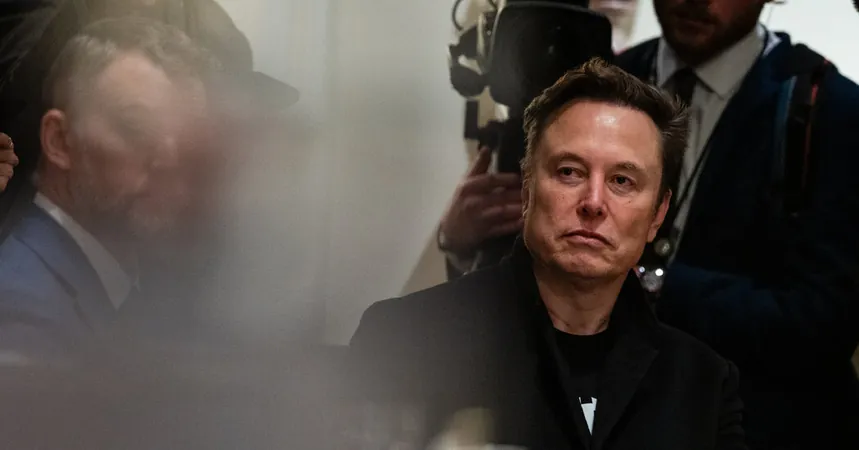
Elon Musk Sounds Alarm: China’s Rare Earth Ban Could Stall Tesla’s Robot Ambitions
2025-04-23
Author: Ling
In a bold statement this week, Elon Musk, CEO of Tesla, highlighted a pressing challenge his company is facing due to China's recent restrictions on rare earth magnets. This situation marks a significant ripple effect from global trade disputes impacting major American enterprises.
China has taken a drastic step, halting exports of critical heavy rare earth metals and their corresponding magnets as retaliation against increased U.S. tariffs imposed by former President Trump. The Chinese government is now formulating a new export licensing system which has led to delays, effectively blocking shipments until further notice.
China dominates the global supply chain for these heavy rare earth metals, sourcing from its own mines as well as those in neighboring Myanmar. Additionally, the country produces 90% of the magnets made from these resources, leaving Japan and a few other nations to account for the remaining production, often using Chinese raw materials.
What’s the big deal about these rare earth magnets? They are incredibly potent—up to 15 times stronger than standard iron magnets, with the added benefit of maintaining their magnetic force even at extremely high temperatures.
During Tesla's recent earnings call, Musk explained how this supply chain disruption could hinder the production of Tesla's futuristic Optimus humanoid robots, which utilize unique electric motors that are highly dependent on these specific magnets. "The supply chain is heavily affected by China’s new licensing demands, and we’re actively navigating this challenge," Musk remarked.
Investment in the Optimus project is significant; Tesla is pouring billions into developing these innovative robots, which Musk envisions will automate various everyday tasks. At a demonstration last fall, he showcased the robots serving drinks and unloading groceries—an exciting glimpse into future possibilities.
In light of Tesla’s recent profit declines, Musk noted he plans to cut back on his advisory role to President Trump, refocusing his efforts on Tesla's overarching goals.
The implications of rare earth magnets extend beyond Tesla; they are crucial components in a variety of technologies, from cars and industrial robots to advanced military equipment.
Legal expert Yang Jie from Huiye law firm in Shanghai indicated that the Ministry of Commerce is expected to process these export licenses within 45 working days. However, geopolitical tensions could extend this timeline significantly—his estimation suggests that it could take up to six months, if not longer, for U.S. shipments to pass through.
Interestingly, not all robotics manufacturers may feel the pinch. Jonathan Hurst, chief robotic officer at Agility Robotics, noted that they can design robots that minimize dependence on rare earth metals, potentially sidestepping some of the current supply issues.
 Brasil (PT)
 Canada (EN)
 Chile (ES)
 Česko (CS)
 대한민국 (KO)
 España (ES)
 France (FR)
 Hong Kong (EN)
 Italia (IT)
 日本 (JA)
 Magyarország (HU)
 Norge (NO)
 Polska (PL)
 Schweiz (DE)
 Singapore (EN)
 Sverige (SV)
 Suomi (FI)
 Türkiye (TR)
 الإمارات العربية المتحدة (AR)