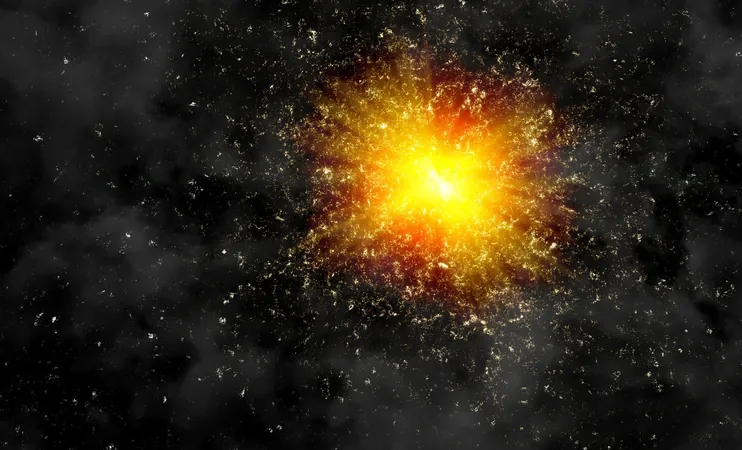
Explosive Discovery: A Stellar Eruption in the Large Magellanic Cloud Sets New Records!
2025-04-21
Author: Ling
A Nova Like No Other!
In an astonishing cosmic event, a repeating nova eruption known as LMCN 1968-12a has erupted in the Large Magellanic Cloud, marking a stunning breakthrough in our understanding of stellar explosions. This eruption has shattered temperature records and revealed unexpected chemical signatures, providing invaluable insight into the evolution of stars.
The Hottest Nova Ever Seen!
Detected in August 2024, this latest explosion has scientists buzzing, being hailed as one of the hottest nova outbursts recorded beyond our galaxy! Occurring approximately every four years, this eruption was different—thanks to the pioneering near-infrared analysis conducted by astronomers utilizing the advanced Magellan Baade and Gemini South telescopes in Chile.
Record-Breaking Heat!
The data collected revealed mind-boggling temperatures soaring up to 5.4 million degrees Fahrenheit (3 million degrees Celsius)! Unlike past observations, the chemical profile of this nova deviated wildly from typical patterns seen in similar events across the Milky Way.
Mysteries in the Chemistry!
What truly captivated researchers were the unexpected findings within the nova's spectral signature. An unusually high amount of ionized silicon was recorded, glowing at 95 times the brightness of our sun across all wavelengths. Curiously missing were typically high-energy elements like sulfur, phosphorus, calcium, and aluminum. This anomaly signals an extremely rare and hot environment, prompting questions about local galactic chemistry's influence on eruption intensity.
The Role of Metallicity!
One factor at play is metallicity—the concentration of heavy elements in a stellar system. The Large Magellanic Cloud boasts a lower metallicity than the Milky Way, which allows vast amounts of hydrogen and helium to accumulate on the white dwarf prior to its explosive eruption. In contrast, more metal-rich environments like our own galaxy usually witness less ferocious explosions.
Understanding Nova Mechanisms!
So, what triggers a nova? It occurs when a white dwarf, the remnant core of a deceased star, siphons gas from a nearby companion star—often a subgiant—forming an accretion disk. As the material accumulates, pressure and temperature rise until a thermonuclear runaway reaction is ignited, producing a dazzling burst of energy and a dramatic spike in brightness.
LMCN 1968-12a: A Cosmic Benchmark!
LMCN 1968-12a has become a landmark of astronomical study since its detection in 1968. With observations revealing a periodic cycle of eruptions every four years since 1990, astronomers have the unique opportunity to delve into the effects of time, composition, and eruption physics over decades. Each outburst not only reshapes the cosmic landscape but also beckons us closer to understanding the dynamic lives of these explosive stars!


 Brasil (PT)
 Canada (EN)
 Chile (ES)
 Česko (CS)
 대한민국 (KO)
 España (ES)
 France (FR)
 Hong Kong (EN)
 Italia (IT)
 日本 (JA)
 Magyarország (HU)
 Norge (NO)
 Polska (PL)
 Schweiz (DE)
 Singapore (EN)
 Sverige (SV)
 Suomi (FI)
 Türkiye (TR)
 الإمارات العربية المتحدة (AR)