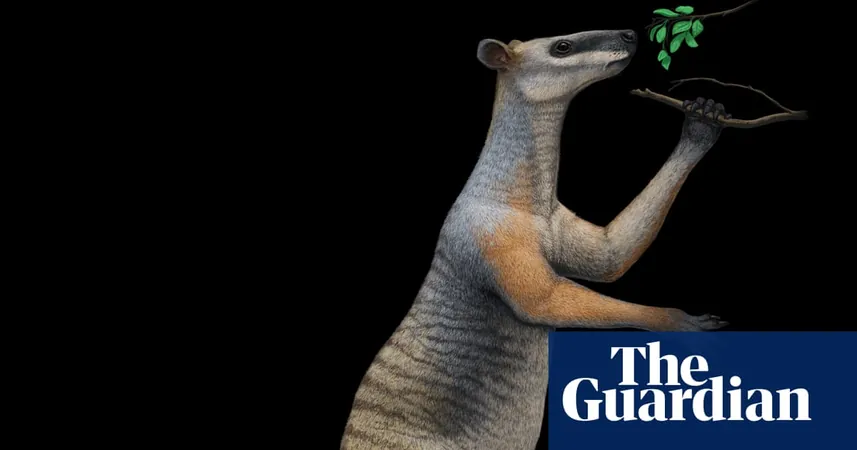
Giant Prehistoric Kangaroos: Homebodies of the Past!
2025-04-23
Author: Wai
Surprising Discoveries in Queensland
Recent studies have revealed that the enormous prehistoric kangaroo species, Protemnodon, preferred to stay home rather than roam far and wide. Researchers from Australia have found that these giant creatures had surprisingly limited ranges, challenging previous assumptions about their behaviors.
Meet Protemnodon: The Colossal Couch Potato
Thriving in Australia from around 5 million years ago to about 40,000 years ago, Protemnodon dwarfed today’s kangaroos, with some individuals weighing in at a staggering 170 kg—more than twice the size of the largest modern red kangaroo. Their size typically suggested expansive territories, but the evidence is telling a different story.
Staying Close to Home
Analysis of fossilized teeth discovered near Mt. Etna, Queensland, showed that these giant kangaroos were more like homebodies, tending to live and die near the limestone caves where their remains were unearthed. According to Dr. Scott Hocknull, co-author and senior curator at the Queensland Museum, these behemoths seemed to thrive in a confined space, preferring to munch on the abundant rainforest leaves nearby.
"They were just chilling at home, surrounded by plenty of food, which allowed them to thrive over hundreds of thousands of years," Hocknull said.
The Risks of a Restricted Range
However, their cozy habits proved detrimental as climate changes began to unfold. The rainforest habitat was disrupted around 280,000 years ago, signaling tough times ahead for the local fauna. Their limited movement left them vulnerable to extinction as conditions changed rapidly.
Diverse Adaptations Across the Continent
Dr. Isaac Kerr, another expert in kangaroo paleontology, noted that Protemnodon fossils found throughout southern and eastern Australia point to a variety of species well-adapted to different environments. These robust kangaroos likely resembled modern wallaroos, being stout and muscular yet still substantially larger.
The Rich Fossil Record of Mt. Etna
Mt. Etna stands as one of Australia's richest fossil sites, offering a glimpse into ancient Pleistocene rainforests and their transition to arid landscapes. The research team is now looking to apply their findings to smaller kangaroo species to understand their survival strategies amidst changing environments.
Innovative Techniques in Paleontology
The study utilized unique chemical signatures from local geology to map the range of these ancient giants. By examining strontium variations in local rock types reflected in fossilized teeth, the researchers believe they can unveil the reasons behind the extinction of certain megafauna species in specific regions.
As Hocknull observed, this groundbreaking approach is set to transform how scientists interpret the fossil record, opening the door to a deeper understanding of prehistoric life.




 Brasil (PT)
 Canada (EN)
 Chile (ES)
 Česko (CS)
 대한민국 (KO)
 España (ES)
 France (FR)
 Hong Kong (EN)
 Italia (IT)
 日本 (JA)
 Magyarország (HU)
 Norge (NO)
 Polska (PL)
 Schweiz (DE)
 Singapore (EN)
 Sverige (SV)
 Suomi (FI)
 Türkiye (TR)
 الإمارات العربية المتحدة (AR)