Hiker Uncovers Stunning Discovery: California's Highest Tree Found in Sequoia National Park!
2025-04-23
Author: Ken Lee
A Remarkable Find at Mount Kaweah
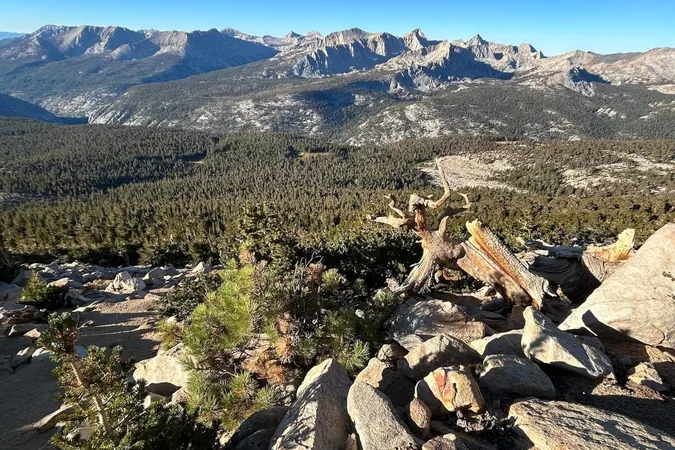
Last September, during a hike on the majestic slopes of Mount Kaweah in Sequoia National Park, Professor Hugh Safford, a forest ecologist from UC Davis, stumbled upon an astonishing sight: a Jeffrey pine towering at over 11,500 feet (3,505 meters). This unexpected encounter left him baffled.
What is a Jeffrey Pine Doing Here?
As Safford trekked through the mountainous landscape, he first saw a foxtail pine, followed by a lodgepole pine—both expected in these harsh, elevated terrains. But when he spotted the Jeffrey pine, he couldn't help but wonder, ‘What is it doing up here?’ This species is typically found in the Sierra Nevada, particularly around Lake Tahoe and Mammoth Lakes, not at such extreme altitudes.
Breaking Records and Expectations
Incredibly, Safford's exploration revealed not just one but numerous Jeffrey pines at even loftier elevations, one reaching an astonishing 12,657 feet (3,858 meters)—which is nearly 1,900 feet (579 meters) higher than any previously recorded instance! This newfound presence could signify that the Jeffrey pine now holds the title of California's highest-living tree.
A Sign of Climate Change?
Safford’s discoveries, documented in the Madroño journal, might be indicative of a warming climate. With earlier snowmelt and rising temperatures, these resilient trees are finding refuge in areas once deemed too frigid and icy for survival.
Who’s Helping the Trees Move?
Interestingly, Safford posits that the Clark’s nutcracker, a bird known for its knack for hoarding pine seeds at high altitudes, may play a crucial role in helping the Jeffrey pine expand its range upward. These birds might be stashing seeds from lower altitudes in cooler, higher zones, leading to the surprising growth of Jeffrey pines in previously uninhabitable heights.
The Unseen Role of Nature
Climate models suggest many tree species are lagging behind with their upward migration as temperatures climb. However, Safford's findings challenge these assumptions, demonstrating the dynamic interplay of living organisms in adapting to climate changes. He states, "I’m observing trees thriving in new habitats while they’re simultaneously vanishing from places they once flourished." This phenomenon of species 'leapfrogging' complicates our understanding of ecological responses to climate warming.
What’s Next for Safford and His Team?
Safford emphasizes the necessity of on-ground research, noting that satellite imagery often fails to capture smaller trees. "To truly understand the impacts of climate change, we must venture out into these high-elevation ecosystems," he insists. This summer, Safford and his students aim to continue their fieldwork around Mount Whitney, Mount Kaweah, and Sequoia-Kings Canyon National Parks, meticulously measuring trees, identifying new seedlings, and mapping the forest's response to our warming planet.
Explore the Study Further
To dive deeper into this riveting study and learn more about the Jeffrey pine's remarkable journey, check out the research publication.
Safford's findings not only unveil a unique aspect of California's ecology but also serve as a crucial reminder of the ongoing impacts of climate change on our natural world.


 Brasil (PT)
 Canada (EN)
 Chile (ES)
 Česko (CS)
 대한민국 (KO)
 España (ES)
 France (FR)
 Hong Kong (EN)
 Italia (IT)
 日本 (JA)
 Magyarország (HU)
 Norge (NO)
 Polska (PL)
 Schweiz (DE)
 Singapore (EN)
 Sverige (SV)
 Suomi (FI)
 Türkiye (TR)
 الإمارات العربية المتحدة (AR)