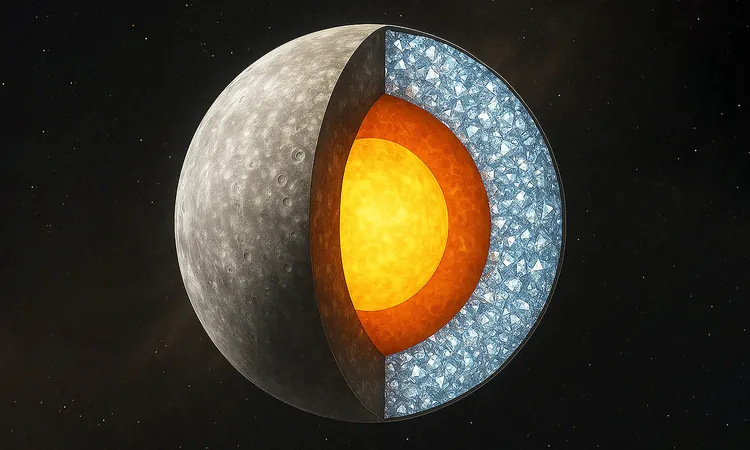
Incredible Discovery: Mercury's Mysterious Diamond Layer Is 10 Miles Thick!
2025-04-19
Author: Ling
Unveiling the Secrets of Mercury
Despite its scorching temperatures and harsh environment, Mercury has revealed a spectacular and startling discovery: a potential layer of diamond approximately 10 miles thick lies hidden beneath its surface. For a planet that spins rapidly—three times on its axis for every two revolutions around the Sun—this revelation is as brilliant as it is unexpected.
A History Written in Carbon
Hints of Mercury’s carbon treasure trove have emerged since NASA's MESSENGER spacecraft conducted extensive mapping of the planet. Patches of graphite, which is a form of carbon, suggest a long-lost magma ocean that was once saturated with carbon. As this ocean cooled, lighter carbon would have floated to the surface, darkening the crust, while denser metals sank.
From Graphite to Diamonds
Recent research led by Dr. Yanhao Lin from the Center for High Pressure Science and Technology Advanced Research indicates that the heavier carbon may have sunk alongside the metals, transforming into diamonds at high pressures and temperatures as deep as the planet’s core-mantle boundary. Through laboratory experiments that simulated Mercury's extreme conditions, the researchers discovered how diamond could form and settle as part of the planet's intricate geological history.
Mercury’s Unique Composition
Under the experimental conditions, it was found that at the core-mantle boundary—where the pressure is staggering—graphite can morph into diamonds thanks to sulfur's influence, which alters the liquid state of Mercury’s magma ocean. This process not only leads to a sparkling diamond layer but also enhances the dynamo effect that sustains Mercury's surprisingly strong magnetic field.
Implications for Other Planets
If true, this newfound diamond layer sets Mercury apart from its rocky cousins like Earth, Mars, and Venus, who lost their carbon to space. Mercury, with its graphite-rich crust and potential diamond reserves, could provide new insights into the formation of other terrestrial planets. The study's findings could apply to similar planets across the galaxy, suggesting that diamond layers could be a common phenomenon.
What Lies Ahead for Mercury Exploration?
Currently, our understanding of Mercury remains limited; no probe has yet investigated its depths. However, the forthcoming BepiColombo mission—a collaboration between European and Japanese space agencies—will enter orbit around Mercury in 2030. Equipped with advanced instruments, it will delve into the planet's gravitational and magnetic properties, potentially confirming the presence of that elusive diamond layer.
Why Does This Matter?
This discovery extends beyond the allure of shiny gems. It provides crucial insights into how carbon influences planetary evolution, affecting everything from heat flow to crust composition. By tracing the journey of carbon on Mercury, scientists refine their models for distant worlds, offering a glimpse into how seemingly barren planets harbor hidden complexities beneath their surfaces. Mercury, often dismissed as just a scorched rock, reminds us of the extraordinary secrets that lie within our solar system.


 Brasil (PT)
 Canada (EN)
 Chile (ES)
 Česko (CS)
 대한민국 (KO)
 España (ES)
 France (FR)
 Hong Kong (EN)
 Italia (IT)
 日本 (JA)
 Magyarország (HU)
 Norge (NO)
 Polska (PL)
 Schweiz (DE)
 Singapore (EN)
 Sverige (SV)
 Suomi (FI)
 Türkiye (TR)
 الإمارات العربية المتحدة (AR)