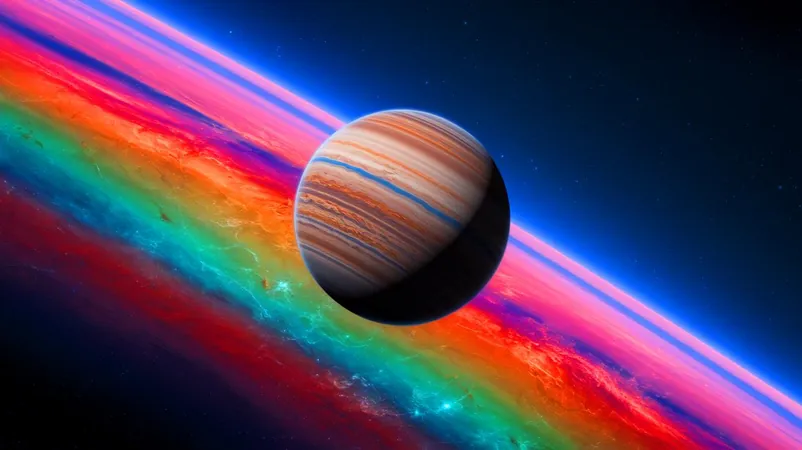
James Webb Telescope’s Jaw-Dropping Discovery on K2-18b: Could We Be on the Verge of Finding Alien Life?
2025-04-22
Author: Jia
Unlocking the Mysteries of K2-18b
In a thrilling revelation, the James Webb Telescope has shone a light on the enigmatic exoplanet K2-18b, located an astounding 124 light-years away in the Leo constellation. This extraordinary world has captured the imagination of scientists and space enthusiasts alike, as new signals detected hint at a possible biosphere that could change everything we know about life beyond Earth.
What Makes K2-18b So Special?
K2-18b is no ordinary planet. Discovered a decade ago, its sheer size is staggering—2.6 times the diameter of Earth and 8.6 times its mass. Scientists speculate that it may be a ‘hycean’ planet, with vast oceans lurking beneath a thick hydrogen-rich atmosphere. The James Webb Telescope is utilizing its advanced MIRI instrument to investigate this distant giant, peeling back layers of mystery to reveal its secrets.
A Glimmer of Hope for Life?
What truly excites researchers is K2-18b’s potential to support life. Each new analysis tantalizingly nudges us closer to understanding this distant world, especially with the recent detection of intriguing chemical compounds.
Revolutionary Chemical Signals
In a remarkable breakthrough, an international team of scientists identified two crucial molecules in K2-18b’s atmosphere: dimethyl sulfide (DMS) and dimethyl disulfide (DMDS). Here on Earth, these compounds are predominantly produced by marine life, raising tantalizing questions about biological processes on K2-18b. Moreover, the presence of methane (CH₄) and carbon dioxide (CO₂) detected earlier only adds to the atmospheric complexity.
Cautious Optimism: Is This Evidence of Life?
The implications of these findings are enormous. The concentration of DMS in K2-18b’s atmosphere is estimated at 10 parts per million—significantly higher than what is typically found on Earth. However, it’s essential for the scientific community to proceed with caution; these compounds might arise from non-biological processes as well.
A Surreal Outlook on the Search for Life
Experts at the University of Cambridge express cautious optimism about the potential for life on K2-18b. They are quick to remind us that while the detected molecules hint at exciting possibilities, there are multiple explanations, including unique geological or chemical phenomena that could explain these signals.
Looking Toward the Future
While a mission to K2-18b remains a distant dream—given that Voyager 1 would take over two million years to reach it—ambitious initiatives like Breakthrough Starshot aim to pursue this bold frontier by traveling at speeds up to 20% of the speed of light.
As technology evolves, the dream of unlocking the secrets of our universe inches closer, paving the way for future explorations that could redefine our understanding of life beyond our home planet.
The Brave New World of Astronomical Discoveries
The tantalizing findings from K2-18b are pushing the limits of our cosmic knowledge. As the James Webb Telescope continues its journey through the universe, one can't help but wonder—what groundbreaking revelations lie ahead in our quest for extraterrestrial life?


 Brasil (PT)
 Canada (EN)
 Chile (ES)
 Česko (CS)
 대한민국 (KO)
 España (ES)
 France (FR)
 Hong Kong (EN)
 Italia (IT)
 日本 (JA)
 Magyarország (HU)
 Norge (NO)
 Polska (PL)
 Schweiz (DE)
 Singapore (EN)
 Sverige (SV)
 Suomi (FI)
 Türkiye (TR)
 الإمارات العربية المتحدة (AR)