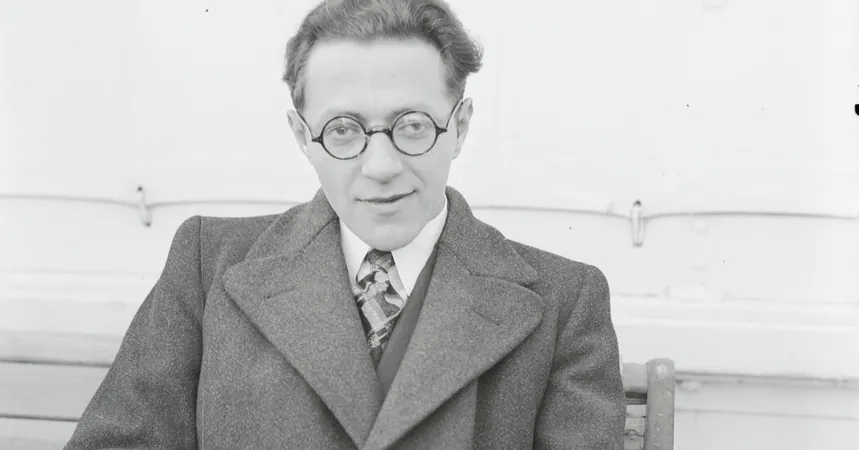
Lost Ashes of a Space Visionary: The Remarkable Tale of Willy Ley
2025-04-21
Author: Jia
In the dimly lit basement of a pre-war co-op on New York City's Upper West Side, a surprising find emerged from the clutter. While clearing out old remnants left by former tenants, the co-op’s superintendent stumbled upon a dusty tin can. The label read: "Remains of Willy Ley. Cremated June 26, 1969." What started as a mundane cleanup transformed into the discovery of a forgotten visionary.
Who Was Willy Ley?
Born in Germany in 1906, Willy Ley was a towering figure in the early days of space exploration. A talented science writer, Ley’s prophetic visions of space travel bloomed in a chaotic era. He witnessed the First World War, and amidst the uncertainty of the 1930s, he began advocating for humanity's potential to journey beyond Earth.
Pioneering the Future of Rocketry
At just 20, Ley penned his first book, "A Trip Into Space," popularizing the concept of rocket travel. He founded the "Society for Space Travel" in 1927, where he rallied young minds, including a fledgling Wernher von Braun, to dream big. Ley famously showcased a modest liquid-fuel rocket in 1930, slyly hinting at its future potential to ferry humans to the moon.
Fleeing Turmoil and Finding a New Home
The rise of the Nazi regime prompted Ley to flee Germany in 1935, taking refuge in Queens, New York. There, he shifted gears, becoming a science writer who forecasted the future of space exploration and penned numerous impactful works, including 1944's “Rockets: The Future of Travel Beyond the Stratosphere.”
A Visionary of Space Exploration
In his groundbreaking writings, Ley didn't just predict space travel; he made it relatable and exciting. He described early concepts of manned missions, warned about potential pitfalls, and echoed the hopes of a society eager to reach the stars. Notably, he foresaw a future with both commercial space travel and renewable energy—predictions that would later come to fruition.
A Tragic Timing
As humanity prepared to embark on its first major lunar adventure, Ley faced a tragic fate. On June 24, 1969, just weeks before Apollo 11's historic launch, he passed away from a heart attack. His ashes would soon find themselves in a forgotten basement, while the world looked to the stars.
Rediscovering a Legacy
The co-op board president, Dawn Nadeau, contacted numerous places to confirm the identity of the remains. After an extensive search, it turned out that Ley's identity was verifiable and that he had no surviving relatives to claim them. Determined to honor his legacy, Nadeau rallied support for a fitting resting place.
An Astral Tribute on the Moon?
Driven by the editorial in Popular Mechanics, which declared it fitting for Ley’s ashes to be scattered on the moon, Nadeau explored options with institutions like the Explorers Club and the American Institute of Aeronautics and Astronautics. Imagine the poetic justice: the man who foresaw humanity’s journey into space finally touching the cosmos he spent a lifetime dreaming about.
A Space Pioneer Finally Recognized
Though Ley's physical remains languished in anonymity for decades, he is now celebrated as a prophet of the space age. With his ashes potentially on course for the moon, this long-overlooked visionary may finally find the celestial resting place he so richly deserves—bringing a fitting closure to an extraordinary tale of aspiration and exploration.

 Brasil (PT)
 Canada (EN)
 Chile (ES)
 Česko (CS)
 대한민국 (KO)
 España (ES)
 France (FR)
 Hong Kong (EN)
 Italia (IT)
 日本 (JA)
 Magyarország (HU)
 Norge (NO)
 Polska (PL)
 Schweiz (DE)
 Singapore (EN)
 Sverige (SV)
 Suomi (FI)
 Türkiye (TR)
 الإمارات العربية المتحدة (AR)