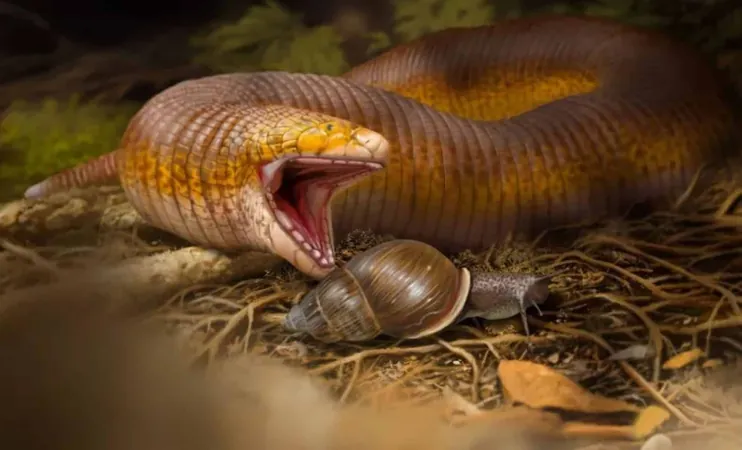
Meet the Jaw-Dropping Giant: The Legendary Worm Lizard of the Eocene Era!
2025-04-20
Author: Ken Lee
A Stunning Discovery: The T. marcelosanchezi
Prepare to have your mind blown! Paleontologists have unveiled a monumental find: the largest worm lizard ever documented, named Terastiodontosaurus marcelosanchezi. This titanic creature, stretching over 3 feet long, is revolutionizing the world of paleontology, pushing the limits of what scientists believed these ancient burrowers could achieve!
Breaking All the Rules!
Unearthed in the stunning landscapes of Djebel Chambi National Park in Tunisia, fossils of T. marcelosanchezi date back roughly 50 million years to the Eocene epoch. Unlike the small, limbless modern worm lizards that thrive underground, this colossal beast was likely an above-ground marvel.
According to lead researcher Georgios Georgalis, "This is large for amphisbaenian standards," highlighting just how much this discovery defies existing norms regarding the size and ecological roles of amphisbaenians, the reptilian group to which these worm lizards belong.
A Real-Life Sandworm: The Anatomy of an Ancient Giant!
The impressive anatomy of T. marcelosanchezi has sparked wild comparisons to the monstrous sandworms from the beloved 'Dune' franchise. Georgalis notes, "Visually, you can imagine the animal as a ‘sandworm’ from the 'Dune' novels and films," emphasizing its imposing size and feeding mechanisms.
Armed with thick tooth enamel and highly powerful jaw muscles, this prehistoric predator was likely a specialist in hunting snails, capable of crushing their hard shells with brute force.
The Largest Worm Lizard Ever!
With an estimated skull length exceeding 2 inches, T. marcelosanchezi stands tall as the largest known member of its lineage, surpassing all known worm lizards, whether extinct or existing today. Researchers have determined that this ancient wonder belongs to the Trogonophid family, a distinctive group of North African worm lizards.
Fossils comprising mostly jaws and vertebrae were discovered in various sizes, indicating that this remarkable species had multiple individuals preserved over ages.
Climate Clues: What Made This Creature So Massive?
The findings also reveal intriguing connections between the size of T. marcelosanchezi and the elevated global temperatures of the Eocene epoch. Co-author Krister Smith from the Senckenberg Research Institute noted, "We believe the unusual body size is related to the higher temperatures during this period of Earth’s history," implying that warmer climates encouraged the evolution of larger bodies.
An Evolutionary Marvel with a Powerful Bite!
Unlike its modern relatives, which are typically three inches or smaller, T. marcelosanchezi turned evolutionary conventions upside down. Researchers have identified "extreme" dental features that enabled this ancient giant to deliver a devastating bite, making it a formidable predator adapted to its ecosystem.
With its significant size and unique habits, this ancient creature illustrates a fascinating chapter in the evolution of reptilian life, warranting admiration and wonder about the mysteries hidden beneath our feet!


 Brasil (PT)
 Canada (EN)
 Chile (ES)
 Česko (CS)
 대한민국 (KO)
 España (ES)
 France (FR)
 Hong Kong (EN)
 Italia (IT)
 日本 (JA)
 Magyarország (HU)
 Norge (NO)
 Polska (PL)
 Schweiz (DE)
 Singapore (EN)
 Sverige (SV)
 Suomi (FI)
 Türkiye (TR)
 الإمارات العربية المتحدة (AR)