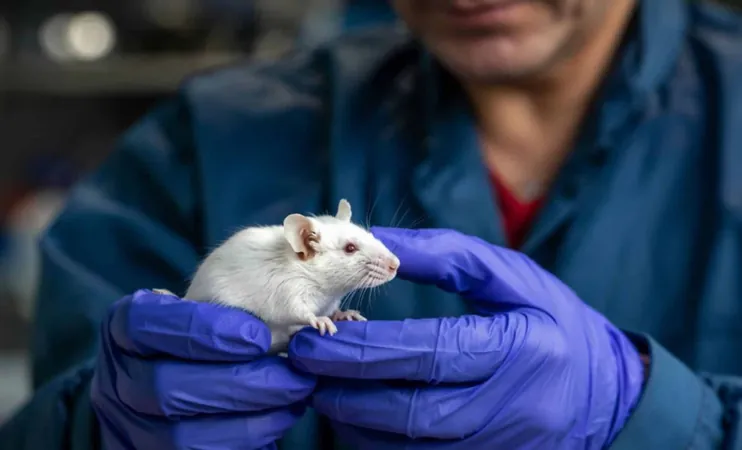
Mice Start Speaking Differently After Scientists Insert Human ‘Language Gene’
2025-04-24
Author: Ling
Revolutionary Research Changes Mouse Communication!
In a groundbreaking experiment that might change our understanding of language and communication, scientists have successfully integrated a human-specific gene called NOVA1 into mice. The implications of this genetic alteration are astonishing, showcasing how a minor tweak at the genetic level can dramatically influence how these tiny creatures communicate.
What Is the NOVA1 Gene?
The NOVA1 gene plays a crucial role in brain development and is common across various species, especially mammals and birds. However, only humans possess a unique variation of this gene that alters the protein it encodes—an essential component in vocalization.
To investigate the gene's influence on communication, researchers from Rockefeller University introduced this humanized NOVA1 into mice. The findings were nothing short of remarkable!
Stunning Results: Mice Are Talking Differently!
Baby mice carrying the humanized NOVA1 gene showed a striking difference in vocalizations compared to their unmodified peers. When calling for their mothers, these specially modified mice emitted higher-pitched squeaks and a richer variety of sounds. This isn’t just a subtle alteration; it provides critical insights into how complex vocal communication could have evolved.
Changes in Vocalization Patterns
In the wild, baby mice communicate using ultrasonic squeaks, categorized into four basic sounds: S, D, U, and M. After the introduction of the human NOVA1 gene, researchers observed significant changes in the emitted sounds, with entire categories of squeak patterns altered.
As the modified mice matured, these differences became even more pronounced, particularly in courtship calls, as male mice showcased a more diverse range of high-frequency sounds.
NOVA1's Role in Evolutionary Language Development
Central to this study is the NOVA1 gene, which encodes a protein that’s vital for RNA binding, brain development, and movement control. While it operates similarly to its mouse counterpart in those areas, it has a remarkable effect on vocalization-related genes.
This direct influence provides a window into why humans have evolved advanced language capabilities compared to other species.
Insights Into Human Evolution!
Significantly, researchers discovered that the human version of NOVA1 is absent in other ancient hominins like Neanderthals and Denisovans. These relatives possessed a similar version of the gene without the unique human variant, highlighting a distinct evolutionary path.
Professor Robert Darnell, the study leader, noted that this genetic shift in NOVA1 may have conferred a notable evolutionary advantage to early humans, possibly facilitating the development of complex speech and communication that sets us apart from other species. “Wow, we did not expect that! It was one of those truly surprising moments in science,” Darnell enthused.
The Future of Communication Research
This fascinating study opens doors to new research directions. Understanding how specific genetic variations affect communication could not only enhance our knowledge of human evolution but also reshape our comprehension of language development across all living species. Imagine the possibilities!


 Brasil (PT)
 Canada (EN)
 Chile (ES)
 Česko (CS)
 대한민국 (KO)
 España (ES)
 France (FR)
 Hong Kong (EN)
 Italia (IT)
 日本 (JA)
 Magyarország (HU)
 Norge (NO)
 Polska (PL)
 Schweiz (DE)
 Singapore (EN)
 Sverige (SV)
 Suomi (FI)
 Türkiye (TR)
 الإمارات العربية المتحدة (AR)