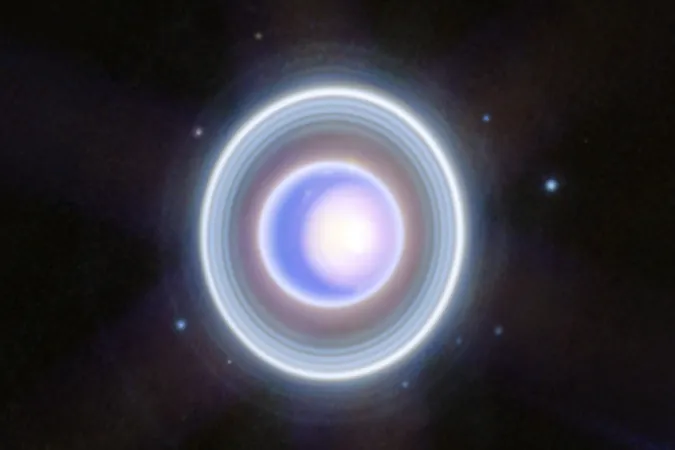
NASA Seizes Rare Cosmic Opportunity to Explore Uranus
2025-04-23
Author: Jessica Wong
Astronomy Marvel: A Stellar Occultation of Uranus
On April 7, a thrilling celestial spectacle occurred as Uranus crossed in front of a distant star, located an astonishing 400 light-years away. This rare event, known as a stellar occultation, offered NASA scientists a unique chance to study the enigmatic ice giant.
During the hour-long phenomenon, the atmosphere of Uranus bent the star’s light, causing it to dim before disappearing completely. Surprisingly, this dimming provided vital clues about the planet, revealing details often hidden from view.
Collaboration Across the Cosmos
In a concerted effort, 30 astronomers from 18 observatories across North America monitored the occultation. They utilized the resulting data to construct a light curve, showcasing how the starlight fluctuated over time. This curve enabled scientists to glean significant information about Uranus's stratosphere, including temperature, density, and pressure across various heights.
"This observation will help us understand how energy circulates in Uranus's atmosphere and the reasons behind its unusually warm upper layers," explained NASA planetary scientist William Saunders. He added that the findings will also contribute to measuring the planet’s rings, atmospheric turbulence, and its precise orbit around the Sun.
Unraveling Mysteries at Cosmic Distances
Despite being nearly 2 billion miles from the Sun, Uranus boasts an upper atmosphere that's hotter than science predicts. The new light curve could shed light on this conundrum.
This monumental collaborative observation marks the first of its kind for a Uranus occultation. In November 2024, scientists conducted a preliminary observation of a fainter Uranus event using telescopes in Asia, which allowed them to refine their timing and adjust the planet's positional data by about 125 miles. This precise targeting is vital for tracking a celestial object 2 billion miles away.
Beyond the Ice Giant: Discovering Uranus’s Rings and Moons
Not only did this event provide insights into Uranus's perplexing atmosphere, but it also gathered crucial information on its 13 rings and 27 moons. Understanding the planet’s exact orbit is critical, especially since it was only visited once by Voyager 2 in 1986, and even now, its exact location is known only within 100 miles.
Uranus, composed mostly of hydrogen, helium, water, ammonia, and methane, is dubbed an ice giant due to its unique internal chemical structure—a cold, gassy slushy filled with fierce winds and storms.
Looking Forward: The Next Occultation in 2031
NASA is already gearing up for another incredible Uranus occultation set for 2031, featuring an even brighter background star. This could lead to airborne or even space-based observations, pushing the boundaries of our understanding of this quirky planet, complete with its tilted axis, mysterious rings, and Shakespearean moons—a thrilling treasure chest of cosmic secrets yet to uncover!





 Brasil (PT)
 Canada (EN)
 Chile (ES)
 Česko (CS)
 대한민국 (KO)
 España (ES)
 France (FR)
 Hong Kong (EN)
 Italia (IT)
 日本 (JA)
 Magyarország (HU)
 Norge (NO)
 Polska (PL)
 Schweiz (DE)
 Singapore (EN)
 Sverige (SV)
 Suomi (FI)
 Türkiye (TR)
 الإمارات العربية المتحدة (AR)