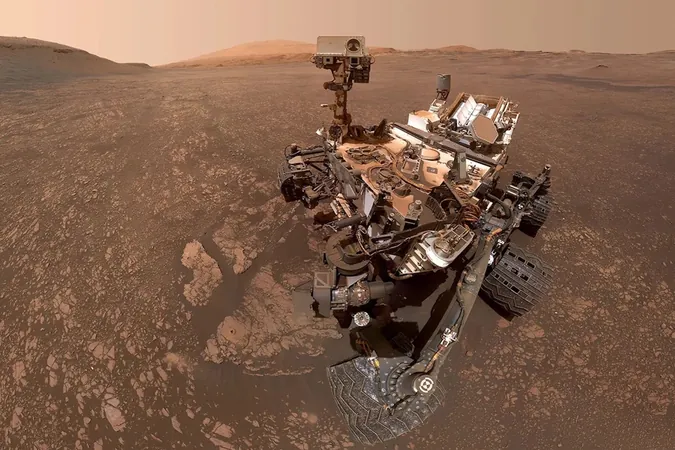
NASA's Curiosity Rover Uncovers Shocking Secrets of Ancient Mars!
2025-04-22
Author: Chun
Unlocking Mars' Mysteries!
For 13 adventurous years, NASA's Curiosity rover has traversed the Martian landscape, unearthing vital clues about the possibility of ancient life on the Red Planet. A groundbreaking recent discovery could finally shed light on the enduring mystery of how Mars transformed from a lush, life-sustaining environment to its current arid state.
Carbon Deposits Found!
Curiosity has made headlines by finding substantial deposits of carbon within the sulfate-rich layers of Mount Sharp, located in the Gale Crater impact basin. A new research paper published in the journal Science reveals compelling data from three drill sites, showcasing an abundance of siderite—an iron carbonate mineral that links to Mars' wetter, habitable past.
The Connection Between Water and Carbon!
Water and carbon dioxide are known to react and form carbonate minerals. Scientists theorize that ancient Mars was enveloped in a thick, carbon dioxide-rich atmosphere, with liquid water flowing across its surface. The recent discovery of carbonate minerals finally supports this theory, something earlier missions couldn't confirm due to insufficient findings.
An Exciting Breakthrough!
Benjamin Tutolo, an associate professor at the University of Calgary and the paper's lead author, expressed excitement: "The discovery of abundant siderite in Gale Crater represents a crucial breakthrough in understanding Mars' geological and atmospheric evolution." This marks a significant milestone as it provides the first mineral evidence to back claims of Mars' once-hospitable conditions.
Atmospheric Changes Over Time!
As Mars’ atmosphere gradually thinned, carbon dioxide transformed into solid rock. This process limited the planet’s ability to retain warmth and sustain surface water, leading to the harsh desert we see today.
How Curiosity Works!
Curiosity uses a specialized drill on its arm to penetrate the Martian rock and collect powdered samples, which it then analyzes using its CheMin instrument. According to Thomas Bristow, a research scientist at NASA's Ames Research Center, "Drilling through the layered Martian surface is like reading a history book—just a few centimeters down can reveal minerals that formed around 3.5 billion years ago!"
Hidden Treasures Await!
Because these carbonate minerals were discovered beneath the Martian surface, they may be obscured by other materials in near-infrared satellite images, explaining previous missions' difficulties in identifying carbonate evidence. If similar minerals exist abundantly in other sulfate-rich areas of Mars, they may have created conditions suitable for warmth and liquid water, proving Mars was once a planet brimming with potential for life.
 Brasil (PT)
 Canada (EN)
 Chile (ES)
 Česko (CS)
 대한민국 (KO)
 España (ES)
 France (FR)
 Hong Kong (EN)
 Italia (IT)
 日本 (JA)
 Magyarország (HU)
 Norge (NO)
 Polska (PL)
 Schweiz (DE)
 Singapore (EN)
 Sverige (SV)
 Suomi (FI)
 Türkiye (TR)
 الإمارات العربية المتحدة (AR)