NASA's Perseverance Rover Unearths Mysterious 'Skull Hill' on Mars—Could It Hold Clues to Alien Origins?
2025-04-24
Author: Ling
A Groundbreaking Discovery on the Red Planet
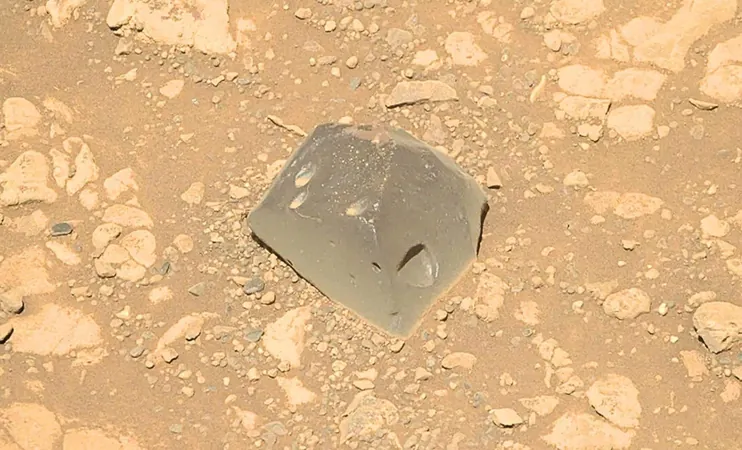
NASA's Perseverance rover has made an astonishing find on Mars that may change everything we know about its geological history. At the edge of the Jezero Crater lies a rock formation intriguingly dubbed "Skull Hill," which stands out with its dark hue, jagged surface, and distinctive pitted texture.
Where Did 'Skull Hill' Come From?
Found at a pivotal site named "Port Anson," where contrasting light and dark rock bands converge, this mysterious formation raises crucial questions about its origins. Geologists classify "Skull Hill" as a "float rock," suggesting that it likely originated from a different location and was transported to its current spot—an intriguing layer of mystery surrounding this already enigmatic rock.
What Sets 'Skull Hill' Apart?
The most striking feature of "Skull Hill" is its dark, angular appearance, sharply contrasting with the surrounding lighter-toned rocks. Its surface is marked by noticeable pits, possibly formed by erosion or wind activity. Additionally, small spherical formations known as "spherules" in the nearby regolith could hold critical insights into Mars' past.
As researchers delve deeper into these spherules, they aim to uncover the environmental conditions that existed on Mars long ago. These structures might have been shaped by volcanic activity or other processes that could have once supported life, prompting speculation about the planet's potential to harbor extraterrestrial organisms.
Could It Be a Meteorite?
Initial examinations led some scientists to consider that "Skull Hill" might be a meteorite, especially given its similarity to dark, iron-rich meteorites discovered by the Curiosity rover in Gale Crater. However, analysis from Perseverance’s SuperCam has suggested otherwise, noting that the chemical makeup of the dark rock does not align with typical meteorites found on Mars.
Is 'Skull Hill' an Igneous Rock?
As alternative theories emerge, scientists are exploring the possibility that "Skull Hill" is an igneous rock, formed from the cooling and solidification of magma or lava over time. Similar to igneous formations on both Earth and Mars, this rock could contain minerals like olivine and pyroxene, explaining its dark coloration.
A Potential Impact Origin?
Yet another intriguing possibility is that "Skull Hill" was blasted into its current location by an impact event, which is known to create debris fields that can scatter fragments across the planet's surface. This would place "Skull Hill" among rocks displaced from the depths of Mars' crust during a violent geological upheaval.
While the theory of an impact origin captivates scientists, further chemical analysis is required to verify or dismiss this possibility. Equipped with cutting-edge instruments, the Perseverance rover is set to continue its assessment of this remarkable rock, promising to shed light on this fascinating chapter of Martian history.



 Brasil (PT)
 Canada (EN)
 Chile (ES)
 Česko (CS)
 대한민국 (KO)
 España (ES)
 France (FR)
 Hong Kong (EN)
 Italia (IT)
 日本 (JA)
 Magyarország (HU)
 Norge (NO)
 Polska (PL)
 Schweiz (DE)
 Singapore (EN)
 Sverige (SV)
 Suomi (FI)
 Türkiye (TR)
 الإمارات العربية المتحدة (AR)