NASA's Rover Uncovers Bizarre 'Skull' Rock on Mars: What's the Mystery?
2025-04-22
Author: Ken Lee
A Strange Discovery on the Red Planet
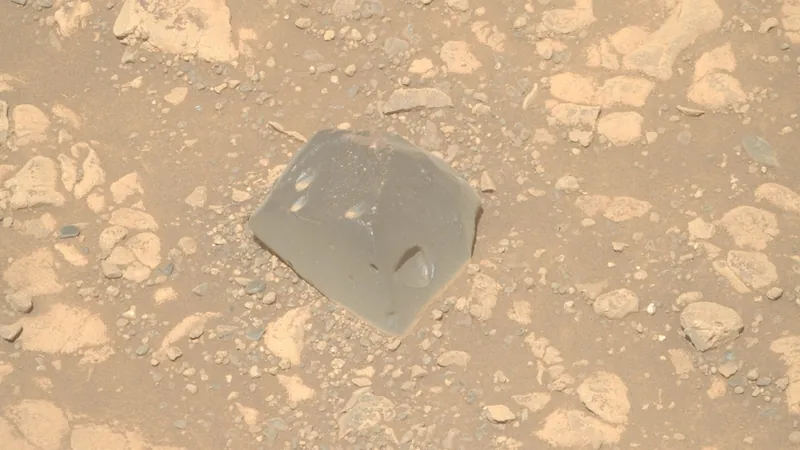
NASA's Perseverance rover continues to astound scientists with its latest find: a peculiar rock formation dubbed "Skull Hill". This striking dark rock stands in stark contrast to the lighter soil surrounding it, raising questions among researchers as they explore Mars' ancient landscapes.
The Quest for Ancient Life
Perseverance is deep into its mission of unearthing signs of past life on Mars, specifically around the Jezero Crater—an area believed to have contained a massive lake billions of years ago. As it maneuvers down the steep slopes of Witch Hazel Hill, scientists are hopeful that new discoveries will shed light on Mars' former climate.
What's So Special About Skull Hill?
Discovered on April 11, Skull Hill is not just a random rock. Its dark color and unique angular texture hint at a fascinating geological history. Found within the Port Anson region, it's one of multiple 'floats'—rocks that have drifted from their original location, likely carried by ancient rivers and lakes when Mars was warmer and wetter.
How Did These Pits Form?
The peculiar pits on the surface of Skull Hill are of particular interest. They could have formed through erosion over time, either from particles breaking away or from Martian winds acting like sandpaper, wearing down the rock's surface. This natural weathering process could reveal secrets about Mars’ atmospheric history.
Could They Be Meteorites?
The dark hue of Skull Hill raises the intriguing possibility that these rocks might be meteorites. However, recent chemical analyses conducted with Perserverance's SuperCam show that their composition diverges from typical meteorites. Therefore, their true origin remains a mystery.
Volcanic Origins?
Another hypothesis posits that these mysterious dark rocks may have come from volcanic activity. On both Earth and Mars, minerals like olivine and pyroxene can create dark-colored igneous rocks, which could hint at volcanic processes that once shaped the Martian landscape.
A Thrilling Scientific Journey
The pace of scientific discovery is accelerating for Perseverance. In recent months, it has collected samples from several unique rocks, engaging in the fastest data collection since its landing. This is especially significant given the challenges of finding scientifically valuable specimens in the crater.
The Team's Excitement
"Crater rims—you have to love them!" exclaims Katie Morgan, the project scientist at JPL. The resurgence of intriguing finds like Skull Hill within the Witch Hazel Hill area has invigorated the science team, and they are eager to uncover even more secrets that Mars still holds.



 Brasil (PT)
 Canada (EN)
 Chile (ES)
 Česko (CS)
 대한민국 (KO)
 España (ES)
 France (FR)
 Hong Kong (EN)
 Italia (IT)
 日本 (JA)
 Magyarország (HU)
 Norge (NO)
 Polska (PL)
 Schweiz (DE)
 Singapore (EN)
 Sverige (SV)
 Suomi (FI)
 Türkiye (TR)
 الإمارات العربية المتحدة (AR)