Neuroscientists on the Brink of Turning Brain Waves into Speech: A Revolutionary Leap Forward!
2025-04-21
Author: Ting
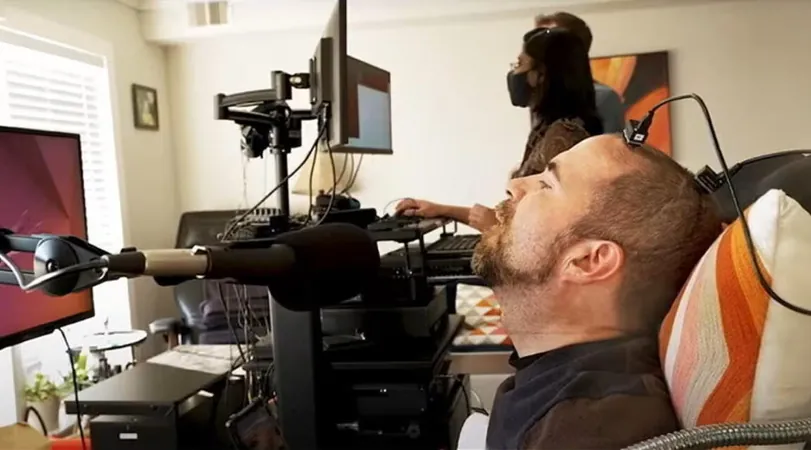
In a groundbreaking quest to give a voice to those unable to speak, neuroscientists are rapidly advancing technologies that convert brainwaves into natural speech. This innovative work aims not only to restore communication but also to enhance physical capabilities for individuals with severe disabilities.
Leading the charge are researchers across California and pioneering companies like New York's Precision Neuroscience. While much focus has historically been on implants that allow the disabled to control computers or robotic limbs, new strides are being made toward generating speech directly through thought.
According to Edward Chang, a neurosurgeon at the University of California, San Francisco, “We are making exceptional progress—creating a brain-to-synthetic voice experience as fluent as natural conversation is our primary goal.” He noted that as AI algorithms improve, they gain valuable insights from each participant, which enhances the technology.
Recent research published in *Nature Neuroscience* demonstrated this potential through a woman with quadriplegia who had not spoken for 18 years following a stroke. By silently practicing sentences with a neural network using 1,024 words, she significantly cut the lag time between her brain signals and the audio output from eight seconds to just one second, closely mirroring the timing of natural speech.
The implications of this technology are enormous—thousands of people experiencing speech loss due to strokes, ALS, or other brain conditions could benefit from such voice prosthetics. There’s hope that even those with conditions like cerebral palsy or autism could find a new way to express themselves.
Business interest is surging around these voice neuroprosthesis advancements. Precision Neuroscience asserts that their implants capture more detailed brain signals compared to academic efforts due to their high-density electrodes. They plan to expand their research with over 31 patients and aim to establish the world’s largest repository of high-resolution neural data.
CEO Michael Mager shared that they recently received regulatory approval to keep their sensors implanted for up to 30 days, paving the way for continuous data collection. Their next goal? To miniaturize the technology and create biocompatible devices for permanent implantation.
While Elon Musk’s Neuralink primarily focuses on allowing individuals with paralysis to control computers, the realm of brain-to-speech technology faces unique hurdles. One significant challenge is the extensive time required for users to train the system. According to BCI researcher Nick Ramsey, understanding how individual brain patterns vary will be key to speeding up this process. If these patterns are similar, training could be done based on previous users, drastically reducing the hours needed for effective communication.
However, this endeavor is not without its limitations. Research primarily targets the motor cortex responsible for speech production, with no current evidence supporting the idea of generating speech from other regions of the brain. As Ramsey points out, it's crucial to consider the ethical implications of 'hearing' a person's inner thoughts, which may not always be appropriate.
Experts acknowledge that while decoding speech may eventually achieve high accuracy, replicating the full expressive capabilities of a human voice—including tone and emotional nuances—remains a significant challenge. Sergey Stavisky from the University of California, Davis, states, “Ultimately, a voice neuroprosthesis should allow users to control pitch and timing, perhaps even enabling them to sing.”
In summary, as neuroscientists continue to unravel the complexities of brain-to-speech technologies, the promise of restoring voices to those in need is shining brighter than ever.
 Brasil (PT)
 Canada (EN)
 Chile (ES)
 Česko (CS)
 대한민국 (KO)
 España (ES)
 France (FR)
 Hong Kong (EN)
 Italia (IT)
 日本 (JA)
 Magyarország (HU)
 Norge (NO)
 Polska (PL)
 Schweiz (DE)
 Singapore (EN)
 Sverige (SV)
 Suomi (FI)
 Türkiye (TR)
 الإمارات العربية المتحدة (AR)