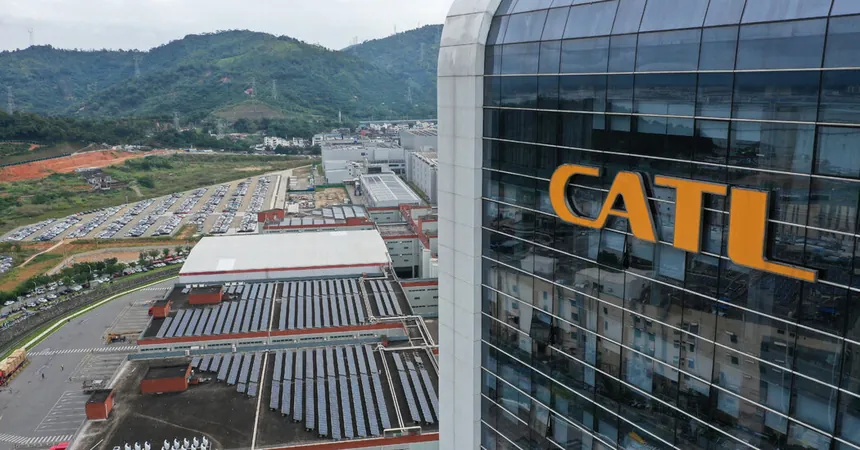
Revolutionary E.V. Battery Breakthroughs: CATL’s Game-Changing Innovations
2025-04-21
Author: Ling
CATL Unveils Groundbreaking Battery Technologies
In a stunning announcement, CATL, the world’s leading electric vehicle battery manufacturer, revealed major technological advancements that promise to transform the electric vehicle (E.V.) landscape. The company, which powers a third of the globe's electric cars, is set to produce lighter, cheaper, and faster-charging batteries that can withstand cold temperatures while boosting driving ranges.
Competitive Edge in the E.V. Market
These innovations, although a few years from widespread adoption, position electric vehicles to compete more fiercely with traditional gasoline-powered cars, enhancing both price and performance. CATL, known fully as Contemporary Amperex Technology Co., Ltd., supplies major automakers like General Motors and Tesla, cementing its status as a pivotal player in the automotive supply chain.
Rethinking Battery Design with Auxiliary Units
One of the most exciting announcements came from CATL regarding auxiliary batteries. These revolutionary batteries will inhabit the undercarriage of vehicles alongside the main battery, eliminating the need for graphite—an expensive component—thus driving costs down.
Gao Huan, CATL's Chief Technology Officer, explained that these new batteries will offer an impressive 60% increase in energy density, meaning more power can be packed into smaller spaces. This not only extends the driving range but also allows for more spacious passenger compartments.
Backup for High-Tech Vehicles
The dual battery system will also provide essential backup power, crucial as self-driving technologies gain traction and require constant electricity to operate smoothly. Ouyang Chuying, CATL's R&D co-president, noted that these innovative auxiliary batteries could hit the market in just two to three years.
The Trade-Offs of Innovation
However, there's a catch. While eliminating graphite may reduce costs and boost energy capacity, it results in slower recharging times compared to conventional batteries. These auxiliary units are intended for occasional use, particularly during longer trips when the main battery is drained.
Revolutionizing Charging Speed
In addition to battery architecture, CATL has made strides in charging speed. Their new technology can deliver enough juice in just five minutes to enable a vehicle to travel 520 kilometers (320 miles), a leap forward in convenience. Competitors like BYD and Huawei are also rolling out similar fast-charging solutions.
Introducing Sodium-Ion Batteries for Extreme Conditions
Moreover, CATL announced it would introduce sodium-ion batteries—resilient enough to function at temperatures as low as -40 degrees Celsius. These batteries aim to replace traditional lead-acid batteries commonly used in cars and are particularly appropriate for regions with harsh winters.
First Auto Works, a truck manufacturer in China’s frigid northeastern region, is set to be the first customer to utilize these innovative sodium-ion batteries. This development caters to the pressing need for reliable power sources in the cold, as many drivers in extreme climates have historically shied away from electric vehicles due to performance concerns.
A Shift in Global Battery Production Dynamics
While CATL is pushing boundaries, it's worth noting that the U.S. holds a strategic advantage in sodium-ion technology, thanks to its rich deposits of soda ash, a vital raw material. As the race for battery innovation heats up, CATL's advancements signal a significant shift toward more versatile, resilient electric vehicle technologies.
With these groundbreaking changes, CATL not only strengthens its position in the E.V. market but also raises the stakes for competitors around the world.

 Brasil (PT)
 Canada (EN)
 Chile (ES)
 Česko (CS)
 대한민국 (KO)
 España (ES)
 France (FR)
 Hong Kong (EN)
 Italia (IT)
 日本 (JA)
 Magyarország (HU)
 Norge (NO)
 Polska (PL)
 Schweiz (DE)
 Singapore (EN)
 Sverige (SV)
 Suomi (FI)
 Türkiye (TR)
 الإمارات العربية المتحدة (AR)