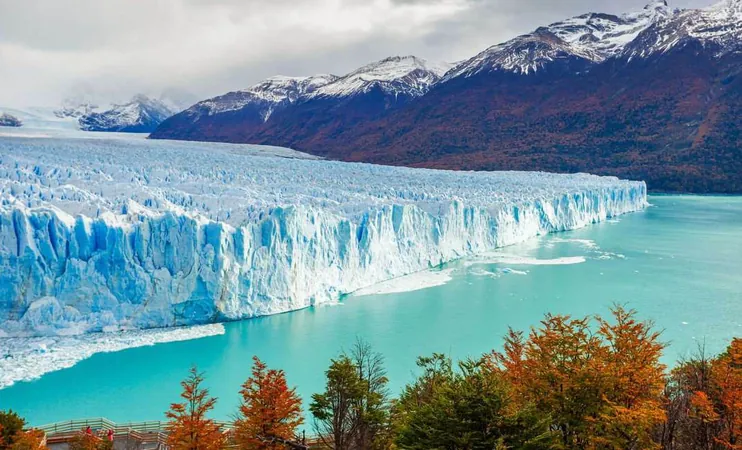
Revolutionary Fiber Optics Unlock Secrets of Swiss Glacier Icequakes
2025-04-21
Author: Jia
A Game-Changer in Icequake Research
At the cutting-edge Seismological Society of America’s 2025 Annual Meeting, scientists unveiled a groundbreaking study that could transform our understanding of glaciers. By utilizing fiber-optic cables, researchers discovered a powerful method to detect and analyze the seismic activity lurking beneath glaciers, focusing on Switzerland’s Gornergletscher.
Eyes Beneath the Ice: A Study Like No Other
Traditional seismic sensors often fall short in treacherous glacial terrains, but a dedicated team from ETH Zürich, led by Tom Hudson and Andreas Fichtner, successfully deployed a dense 2D fiber-optic grid across a crevasse field on the Gornergletscher, Switzerland’s second-largest glacier. Their mission? To capture the elusive seismic signals produced by icequakes, specifically the cracks formed as the glacier shifts and fractures.
These icequakes differ significantly from tectonic quakes; they are created by fractures in ice rather than shifting landmass pressures. Remarkably, fiber optics, commonly associated with telecommunications, proved to be exceptionally good at capturing these subtle seismic events.
Unlocking Glacier Dynamics and Stability
Each detected icequake—951 in total—provides crucial insight into the glacier's internal stresses and fractures. The newly developed method allows for a clearer view of dynamic subglacial activities, turning the spotlight on processes often missed by traditional instruments.
Crevasses play a critical role beyond just surface aesthetics; they channel meltwater to the glacier's base, potentially speeding up ice flow—a significant factor influencing glacial melting and sea-level rise.
Innovation Overcomes Traditional Challenges
Fiber-optic cables are uniquely equipped to succeed in this unstable environment. Strategically deployed as autumn shifted to winter, the black-coated fibers absorbed sunlight, allowing them to thaw into the glacier during the day before freezing overnight, creating optimal contact with the ice.
This ingenious coupling enabled the detection of low-frequency signals that typical sensors often overlook. Such frequencies can endure for hours or even days.
Data That Changes the Seismic Game
The remarkable fiber-optic grid generated 20 times more data than standard seismic nodal arrays, enhancing both spatial and temporal resolution dramatically. This extensive dataset provided an unprecedented view of the seismic activity—shedding light on how waves propagate and resonate through the glacier.
Some seismic events were recorded within a mere 10 meters of the fiber cable, marking an astonishing leap in monitoring capabilities.
Broader Implications for Science and Beyond
While the primary aim was to delve into glacier dynamics, the implications could reach far and wide. The research team believes this groundbreaking fiber-optic technique may offer a novel way to monitor crack formations in various environments, including carbon capture reservoirs, geothermal sites, and even volcanic regions.
Thanks to the predictable seismic profile of glacier ice, this method serves as a testbed with the potential to be adapted for more intricate geological scenarios.
Mapping the Future of Glacial Research
Looking ahead, Hudson aims to take this research further by creating a three-dimensional seismic map of the glacier's interior. Such insights would enable scientists to assess fracture density and the extensive damage to glacial ice, paving the way for advancements in predicting glacier behavior amid climate change and its effect on global sea levels.

 Brasil (PT)
 Canada (EN)
 Chile (ES)
 Česko (CS)
 대한민국 (KO)
 España (ES)
 France (FR)
 Hong Kong (EN)
 Italia (IT)
 日本 (JA)
 Magyarország (HU)
 Norge (NO)
 Polska (PL)
 Schweiz (DE)
 Singapore (EN)
 Sverige (SV)
 Suomi (FI)
 Türkiye (TR)
 الإمارات العربية المتحدة (AR)