Revolutionary New Theory Reveals the Hidden Dance of Light in Classical Interference
2025-04-25
Author: Yan
Unveiling the Mystery Behind Light's Interaction.
In a groundbreaking intersection of classical and quantum physics, researchers from the Federal University of São Carlos, ETH Zurich, and the Max Planck Institute of Quantum Optics have unveiled a fascinating new theory on how classical light interference works. Their recent study, published in the prestigious Physical Review Letters, bridges the gap between the seemingly opposing worlds of classical physics, where electromagnetic waves can't interact when their fields cancel out, and quantum mechanics, which suggests otherwise.
Bright and Dark States: The New Language of Light.
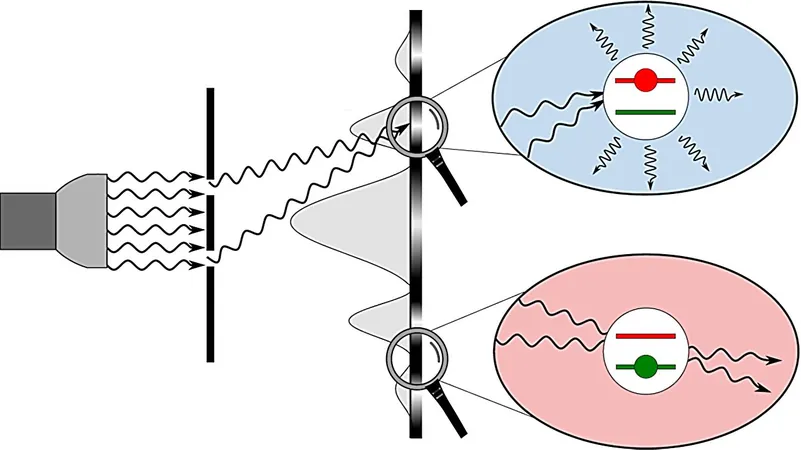
At the heart of this study is the concept of specific two-mode binomial states, which describe collective 'bright' and 'dark' states of light. The lead researcher, Gerhard Rempe, explained how his collaboration with Celso J. Villas-Boas sparked this revolutionary idea. By exploring the effects of quantum information experiments, they considered how light fields in superpositions of zero and one photon interact, fundamentally reshaping the old narratives from the 1950s.
A Game-Changer for Quantum Optics.
Villas-Boas, drawing on the historical work of physicist Robert Dicke, proposed a scenario where atoms could be replaced by optical modes. These modes could contain photons or not, leading to exciting implications for atomic excitation through light. Their new framework likens classical standing waves to the alternating shimmer of bright and dark states of photons, creating a fresh perspective on interference patterns.
Observing the Unobservable: The New Frontier.
Perhaps the most intriguing aspect of their research is the concept of 'dark states.' Unlike their bright counterparts, dark states harbor photons that are virtually invisible to conventional experimental methods. This begs the question: what else could be hidden within these dark realms of light?
Redefining Classical Interference.
The study challenges traditional notions of interference, suggesting that the presence of a 'which-path' observer alters photon detection without affecting their trajectory. This implies that subtle observations can shift a particle from a dark state to a bright one, offering a novel quantum explanation for classical wave interference that integrates insights from historic scientific debates.
A New Lens on Light's Behavior.
Ultimately, Rempe believes this groundbreaking research will inspire future investigations into light's behavior, paving the way for a deeper understanding of classical interference phenomena. He hints at potential studies involving material particles observed through more practical means like ionization devices, underscoring that the implications of their findings stretch far beyond theoretical physics.
A Paradigm Shift for Science.
This study acts as a catalyst, propelling forward our understanding of light as not just waves, but a complex array of quantum particles. As scientists continue to unravel these mysteries, we stand on the cusp of revelations that could redefine our foundational views of physics.
 Brasil (PT)
 Canada (EN)
 Chile (ES)
 Česko (CS)
 대한민국 (KO)
 España (ES)
 France (FR)
 Hong Kong (EN)
 Italia (IT)
 日本 (JA)
 Magyarország (HU)
 Norge (NO)
 Polska (PL)
 Schweiz (DE)
 Singapore (EN)
 Sverige (SV)
 Suomi (FI)
 Türkiye (TR)
 الإمارات العربية المتحدة (AR)