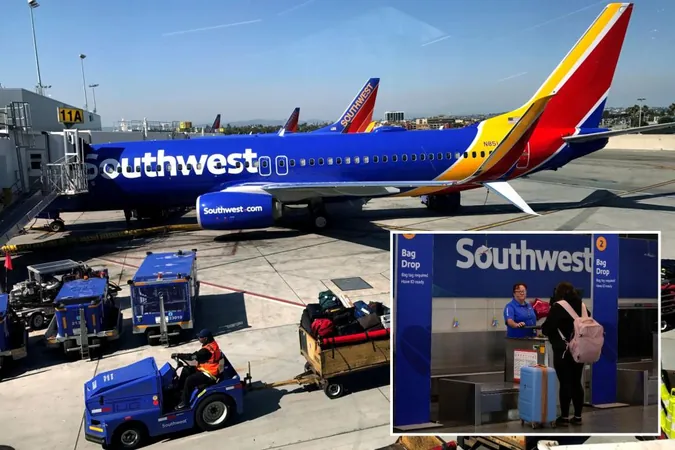
Southwest Airlines Cuts Flights and Forecasts Amid Economic Turmoil
2025-04-23
Author: Lok
In a stunning announcement, Southwest Airlines has joined the ranks of major US carriers like Delta and United by withdrawing its financial forecasts due to the uncertainty created by President Trump’s trade war. This latest move marks a significant shift in the airline industry, as they grapple with unpredictable consumer behavior in the face of a potential economic downturn.
Travel has become a discretionary expense for many, and as the trade war looms, consumers and corporations alike are cutting back on spending. This has led to a noticeable decline in travel demand, forcing airlines to rethink their financial future.
Southwest has officially abandoned its previous projections, which estimated $1.7 billion in earnings before interest and taxes for 2025 and around $3.8 billion for 2026. In their own words, the airline stated, "Amid the current macroeconomic uncertainty, it is difficult to forecast given recent and short-lived booking trends." Following this revelation, Southwest’s shares dipped by 3% in after-hours trading.
Alaska Air Group also pulled its 2025 profit forecast on the same day, echoing the sentiments of its competitors who have struggled with the economic climate. Earlier this month, Delta Air Lines and Frontier Airlines scrapped their forecasts altogether, while United Airlines perplexingly provided two contrasting predictions, underscoring the challenging forecasting environment.
Just a couple of months ago, the outlook for US airlines seemed bright, fueled by booming travel demand and tightened capacity forecasts that hinted at a profit surge. However, the stark reality now reveals a regression, particularly for airlines like Southwest that primarily cater to price-sensitive leisure travelers and focus heavily on the domestic market, which shows the softest demand.
To stimulate an ailing domestic travel market, many airlines are resorting to lower fares. Unfortunately, consumer spending is weakest among lower-income households, further complicating recovery efforts.
In its recent assessments, Southwest noted a decline in bookings throughout the March quarter, especially in domestic leisure travel—its mainstay. The company expects unit revenue, a measure of pricing power, to fall up to 4% year-over-year in the current quarter, signaling deepening challenges ahead.
In the wake of COVID-19, Southwest has struggled to regain its footing, facing pressure to adapt its business model. Last year, it announced plans to end its iconic open seating policy, and just last month, it revealed intentions to impose charges for checked bags—a departure from a longstanding complimentary service.
Despite these controversial changes, CEO Bob Jordan has asserted that there’s been no sign of customers abandoning the airline. The company is set to introduce a basic economy fare and bag fees next month, with plans to start selling assigned and extra legroom seats by the fall.
In a bid to safeguard its profit margins amidst declining demand, Southwest is taking proactive steps to reduce capacity in the latter half of the year. In its latest earnings report, the airline reported an adjusted loss of 13 cents per share in the first quarter, a slight improvement compared to the anticipated loss of 18 cents.
Southwest is scheduled to discuss its financial results further on a call with analysts and investors tomorrow, highlighting the urgent need to navigate these turbulent skies.
 Brasil (PT)
 Canada (EN)
 Chile (ES)
 Česko (CS)
 대한민국 (KO)
 España (ES)
 France (FR)
 Hong Kong (EN)
 Italia (IT)
 日本 (JA)
 Magyarország (HU)
 Norge (NO)
 Polska (PL)
 Schweiz (DE)
 Singapore (EN)
 Sverige (SV)
 Suomi (FI)
 Türkiye (TR)
 الإمارات العربية المتحدة (AR)